



Both are FCA-authorised electronic money institutions: Airwallex (UK) Limited under FRN 900876, Stripe Payments UK Ltd under FRN 900461. Both safeguard your money rather than holding it under FSCS. We confirmed both on the FCA register on 9 October 2026.
The split used to be simple: Stripe for everything, Airwallex for foreign currency. Two changes in 2026 muddied that.
First, Airwallex launched UK card hardware in April 2026, the M90 terminal and SoftPOS on a phone. It now takes payments at the counter, which it could not do a year ago.
Second, Airwallex Billing caught up. It now handles dunning, proration and metered billing natively. The one piece still missing is a ready-made customer self-service portal, which Stripe has and Airwallex has on its roadmap.
So the decision comes down to foreign currency. If more than 15 to 20% of your revenue lands in euros or dollars, Airwallex’s 0.5% FX margin against Stripe’s 2.0% conversion surcharge is the number that decides it.
If you bill only UK clients in pounds, Stripe’s developer depth, marketplace product and mature billing portal usually justify the slightly higher card rate.
Which Is Better for UK Online Businesses?
The deciding question is how much foreign currency you handle, not whether you sell online or in a shop.
Take a UK SaaS founder billing 800 subscribers at £29 a month, all in pounds. Stripe is still the call. Stripe Billing ships trials, proration, dunning and a customer self-service portal out of the box.
Airwallex now matches the billing logic, dunning, proration and metered usage, but its self-serve portal is still on the roadmap. For a pounds-only subscription business, the 0.2-point card saving does not pay for that gap.
Now take a UK Shopify store doing £200,000 a year, 40% of orders from EU buyers, so around £80,000 in euros. Stripe converts those euros to pounds at 2.0% the moment they settle, unless you set up its multi-currency settlement and add a euro bank account.
Airwallex receives the euros into a real EUR account, lets you hold them, and converts at 0.5% when you choose. On £80,000 that is roughly £1,200 a year saved on FX alone.
Add the slightly lower EEA card rate, 2.40% against Stripe’s 2.5%, and the saving lands near £1,300 a year for an owner-run brand at that scale. We ran those numbers from both providers’ own pricing pages.
For a UK consultancy invoicing US clients in dollars, Airwallex wins clearly. The dollars land in an Airwallex US-routing-number account; you sit on them and convert when the rate suits, rather than taking whatever Stripe gives you on payout day.
And the old tie-breaker is gone. A Manchester florist taking 30 card payments a week can now run Airwallex at the counter on the M90 or SoftPOS, where a year ago it would have needed a second provider.
Stripe vs Airwallex Fees and Charges
Card Transaction Fees
Stripe’s online UK rates: consumer Visa and Mastercard 1.5% + 20p, premium UK cards 2.8% + 20p, EEA cards 2.5% + 20p, non-EEA international 3.15% + 20p.
Stripe prices every American Express card as a standard UK card, at 1.5% + 20p. In person, Stripe Terminal is 1.4% + 10p on UK cards. (Source: stripe.com/gb/pricing, 5 October 2026.)
Airwallex on the Explore plan: UK cards 1.30% + 20p, EEA cards 2.40% + 20p, non-EEA 3.15% + 20p, Amex 2.40% + 20p. Lower on UK domestic, a touch lower on EEA, the same on non-EEA, and dearer on Amex.
On £500,000 a year of UK-only card volume, Airwallex’s 1.30% saves you roughly £1,000 against Stripe’s 1.5% on the headline rate alone. That is the floor. The FX gap is where the real money sits.
Monthly, Setup and Contract Costs
Neither charges a monthly fee on its base tier the way a card-machine rental would. Stripe is pure pay-as-you-go: no subscription, no minimum, no commitment.
Airwallex’s Explore plan is free, though the fee defaults to £19 a month in any month your balance or deposits fall under £10,000. The Grow plan is £49 a month; Accelerate is custom-priced.
One thing the paid tiers do not buy is a lower FX margin. Airwallex charges 0.5% above interbank on major currencies across every plan, so you are not paying for a higher plan to shave the conversion rate.
On Stripe, the add-ons stack. Stripe Billing adds a percentage of recurring volume on top of the card rate, and Radar for Fraud Teams adds a few pence per screened transaction. Basic fraud screening is bundled.
Neither asks for a bespoke contract or a minimum volume at standard tier. You can sign up and close in the same week.
Other Fees to Watch
FX is the biggest hidden line in this comparison, and the gap is wider than it used to be. Stripe adds 2.0% whenever the payment currency differs from your settlement currency. Settle in pounds and every euro or dollar sale carries it.
Airwallex charges 0.5% above interbank on the major currencies. That is a 1.5-point gap, the single strongest reason to choose Airwallex if you carry cross-border volume of any size.
On disputes, Stripe charges £20 a chargeback, refunded if you win. Airwallex charges its chargeback fee once per dispute and says the amount differs by payment method, but it publishes no UK figure. Small in isolation, but it adds up in a high-chargeback category.
Stripe Instant Payouts cost 1%, minimum 40p, over Faster Payments. Airwallex GBP payouts to UK banks are free; international SWIFT transfers cost £10 to £20 each.
Airwallex does not charge a monthly fee to hold dollar, euro or other supported balances on Explore. You can sit on a currency until a supplier invoice in the same currency lands, and skip the conversion entirely.
If you want to escape card fees on big invoices, Stripe Pay by Bank is an option, priced at 0.5% + 20p and capped at £5 a payment. Its other published bank-based rate is the one for Bacs Direct Debit: 1% with a 20p minimum, capped at £4 a payment, which on a £9,000 invoice is £4 against about £135 on a card.
Fee Verdict: Who Costs Less
Airwallex is cheaper on the headline UK card rate, 1.30% against 1.5% + 20p, worth about £1,000 a year per £500,000 of UK volume.
The FX gap matters more. Around £1,200 saved per £80,000 of euro conversion, once you set Airwallex’s 0.5% against Stripe’s 2.0%. Add the EEA card edge and it is near £1,300 a year on that profile.
For a UK-only merchant with no foreign currency, the card-rate gap is real but small, and Stripe’s developer depth and billing portal often justify the difference. Above roughly £50,000 a year of cross-border volume, Airwallex wins on cost. That is the threshold.
Stripe vs Airwallex Payment Methods and Checkout Options

Cards, Wallets and Alternative Payment Methods
Both take Visa, Mastercard, American Express, Apple Pay and Google Pay. The differences start past cards and wallets.
Stripe carries the broader alternative-payment suite for UK and European buyers: Bacs and SEPA Direct Debit, iDEAL, Klarna, Clearpay, Stripe Link, Bancontact and more.
If you sell into Europe or North America, that BNPL stack is a real edge. Airwallex supports Klarna but not Clearpay, so a UK fashion brand chasing younger US buyers feels the gap.
Airwallex is stronger for Asia-Pacific: Alipay, WeChat Pay, plus local methods across Australia, New Zealand, Mexico and Brazil, alongside SEPA and iDEAL for the EU.
If your buyers are APAC-heavy, local-currency settlement matters as much as the method. Customers see their own currency at checkout, which lifts conversion in a way Stripe’s pure-card flow does not.
Checkout Experience
Stripe’s checkout stack is the deeper one: hosted Checkout, no-code Payment Links, and the embeddable Payment Element that surfaces region-relevant methods on its own.
Stripe Link is the one-click wallet for anyone who has checked out on a Stripe store before. It strips friction for returning buyers across the whole Stripe network, and Airwallex has no equivalent at that scale.
Airwallex gives you a hosted payment page, a drop-in element, no-code links and a full checkout SDK. Its localisation is sharp for APAC, surfacing local methods by region without you writing the logic.
Methods Verdict
Stripe wins on payment-method breadth for UK, European and North American buyers, and on checkout polish if you have engineers building the flow.
Airwallex wins on APAC coverage paired with local-currency settlement. For a standard UK or EU card business, neither gap will decide it. We rate this close enough to settle on cost and currency instead.
Stripe vs Airwallex Hardware, POS and In-Person Payments

Card Readers and Terminals
This is the section that changed most in 2026. Stripe Terminal is still available in the UK: the BBPOS WisePad 3 at £49 and the Stripe Reader S700 or S710 at £229, both excluding VAT and bought outright. In-person processing is 1.4% + 10p on UK cards.
Airwallex used to have nothing here. As of April 2026 it does. The M90 is an Android terminal with a built-in card reader and printer, and SoftPOS turns an Android or Apple phone into a reader with no extra hardware.
So a UK merchant taking the odd card across a counter no longer needs a second provider alongside Airwallex. That was the single biggest reason to default to Stripe in person, and it is gone.
Stripe still has the longer track record in person, more documented integrations and a deeper hardware range. Airwallex publishes no UK terminal price at all, which tells you something on its own about how new the kit is: you cannot cost a shop floor from its website the way you can with Stripe or Square.
POS Software and Hardware Add-ons
Stripe Terminal sits inside the same dashboard as your online payments: one reporting view, one dispute queue, one reconciliation flow. Your bookkeeper does not need a second login.
Stripe does not ship its own till app; it partners with POS providers like Lightspeed, and the Terminal SDK is how third-party software plugs into Stripe’s rails.
Airwallex’s POS offer is newer and thinner on third-party POS integrations, but the M90 and SoftPOS feed the same Airwallex dashboard you use for online and FX. For a business already running Airwallex for currency, that single view is the draw.
In-Person Verdict
Stripe is still the safer in-person pick if the shop floor is the heart of the business: longer track record, deeper hardware range, more POS integrations.
But Airwallex is no longer a non-starter at the counter. If most of your trade is online and cross-border and you take the occasional card in person, the M90 or SoftPOS now keeps it all under one roof. We rate that a genuine shift from a year ago.
Stripe vs Airwallex Online Payments and Integrations
Hosted Checkout, Payment Links and APIs
Stripe’s API is the developer benchmark in payments: hundreds of endpoints, official SDKs in seven languages, and the largest third-party tooling ecosystem in the category.
If your engineers have built on Stripe before, moving costs real time, fewer answers when something breaks at 11pm. Airwallex’s API is genuinely strong in its own right, with SDKs across the main languages and full coverage of cards, FX and payouts.
On subscriptions, the gap has closed. Airwallex Billing now does dunning with dynamic retry schedules, proration on mid-cycle changes, and metered usage billing. A year ago that was Stripe’s clear advantage.
What Stripe still has out of the box is a hosted customer self-service portal, where subscribers update cards and manage plans themselves. Airwallex has that on its roadmap but not yet shipped as a native feature, so confirm its status before you depend on it.
For marketplaces, Stripe Connect is still the more mature product: Standard, Express and Custom accounts, KYC on connected sellers, and tax-form collection as one product. Airwallex’s connected-accounts tooling is improving but still needs more manual reconciliation at that shape.
Platform Integrations (Shopify, WooCommerce, Xero, QuickBooks, etc.)
Stripe integrates with every major e-commerce platform, Shopify, WooCommerce, Magento, BigCommerce, every major accounting tool, and thousands more through its app marketplace.
Airwallex covers the tools most UK merchants actually run, Xero, QuickBooks, WooCommerce, Shopify, Magento and NetSuite, plus Amazon and Etsy for marketplace payouts. The list is shorter but it hits the common stack.
Airwallex also offers no-code batch transfers for paying overseas suppliers and contractors. Stripe has no built-in equivalent.
If you import and pay 20 suppliers a month in CNY and USD, Airwallex batch payments do in one step what would otherwise mean bolting Wise or a bank wire on top of Stripe.
Online Verdict
Stripe still wins on integration breadth, marketplace maturity and the customer billing portal. If you run a marketplace or need self-serve subscription management today, Stripe’s tooling earns the slightly higher rate.
Airwallex wins on multi-currency API depth, international payout tooling and FX infrastructure, and it has now closed most of the subscription-billing gap. If holding and converting currency is part of how you run the business, its stack is built for that and Stripe’s is not.
Stripe vs Airwallex Payouts, Contract Terms and Account Risk
Settlement Speed and Payout Schedule
Stripe settles to your UK bank on a rolling basis, daily once the account is established, with no choice over currency timing. Receipts sweep to your account and convert to pounds at that point.
Stripe Instant Payouts move money in minutes over Faster Payments for 1%, minimum 40p. Useful, but you still do not pick the FX rate.
Airwallex settles card receipts into a multi-currency wallet, where you hold balances in 20-plus currencies with real local account details in each, a UK sort code, a US routing number, a euro IBAN.
GBP payouts to UK banks are typically same-day on demand. The hold-and-convert model is the working-capital edge: you decide when to turn dollars or euros into pounds, rather than taking the payout-day rate.
If a supplier invoice in euros is coming next month, you simply keep the euros.
Contract Length and Exit Terms
Both are pay-as-you-go with no long-term contract and no minimum monthly volume. You close either account from the dashboard, with no exit penalty.
Outstanding balances settle on the normal schedule after you stop. That is the deal at both, and it is a fair one.
Reserves, Holds and Account Stability
Both can hold funds during a risk review. Stripe’s automated systems show up across Trustpilot and merchant forums as a recurring complaint, especially account freezes for unusual transaction patterns or a high-risk profile.
Airwallex’s onboarding is more document-heavy upfront, given the cross-border FX it carries. Some merchants report follow-up requests partway through review. Annoying, but not the same as a sudden freeze on live funds.
If your patterns are steady and your category is clean, both risks are manageable. Neither is safer for genuinely high-risk trades; both will close accounts that drift into regulated verticals. Keep a buffer either way.
Stripe vs Airwallex Customer Reviews and Reputation
Trustpilot and Independent Review Themes
Stripe sits at 1.6 out of 5 on Trustpilot from more than 17,000 reviews as of October 2026. Read that with care: payment processors draw complaint-heavy reviews, mostly from small merchants frozen without warning.
The positive reviews almost always cite integration ease and documentation. The product is not the complaint. The risk system is.
Airwallex sits at 2.9 out of 5 from around 2,600 reviews. Higher, but not glowing. Praise goes to FX savings and the multi-currency wallet; the gripes are compliance document requests and the odd FX-rate query.
We read the recent reviews on both, not just the headline scores. The gap partly reflects Airwallex’s more B2B, tech-literate base against Stripe’s mass of small online merchants. Both effects are real.
Support Channels and Response Times
Stripe support runs mostly through email and in-dashboard chat. Phone exists for enterprise and critical issues, but it is not a standard channel. You will not get a person on the line at 4pm on a Friday.
Its documentation and developer community are unmatched, which is fine if you can search your way to an answer before support replies.
Airwallex offers email and chat, with a named account manager on the Grow and Accelerate plans or at meaningful volume. If you want a human escalation point baked in, that is a practical edge over Stripe’s mostly asynchronous model.
Reputation Verdict
Airwallex takes the support point at any real volume, and its Trustpilot score sits well above Stripe’s. Stripe wins on documentation depth, developer community, and brand recognition for enterprise procurement.
Do not read Stripe’s 1.6 as poor product quality; it reflects the complaint asymmetry of payment processors, not the API. But if account stability is your nightmare, the pattern is real. We weight it accordingly.
Stripe vs Airwallex for International Payments
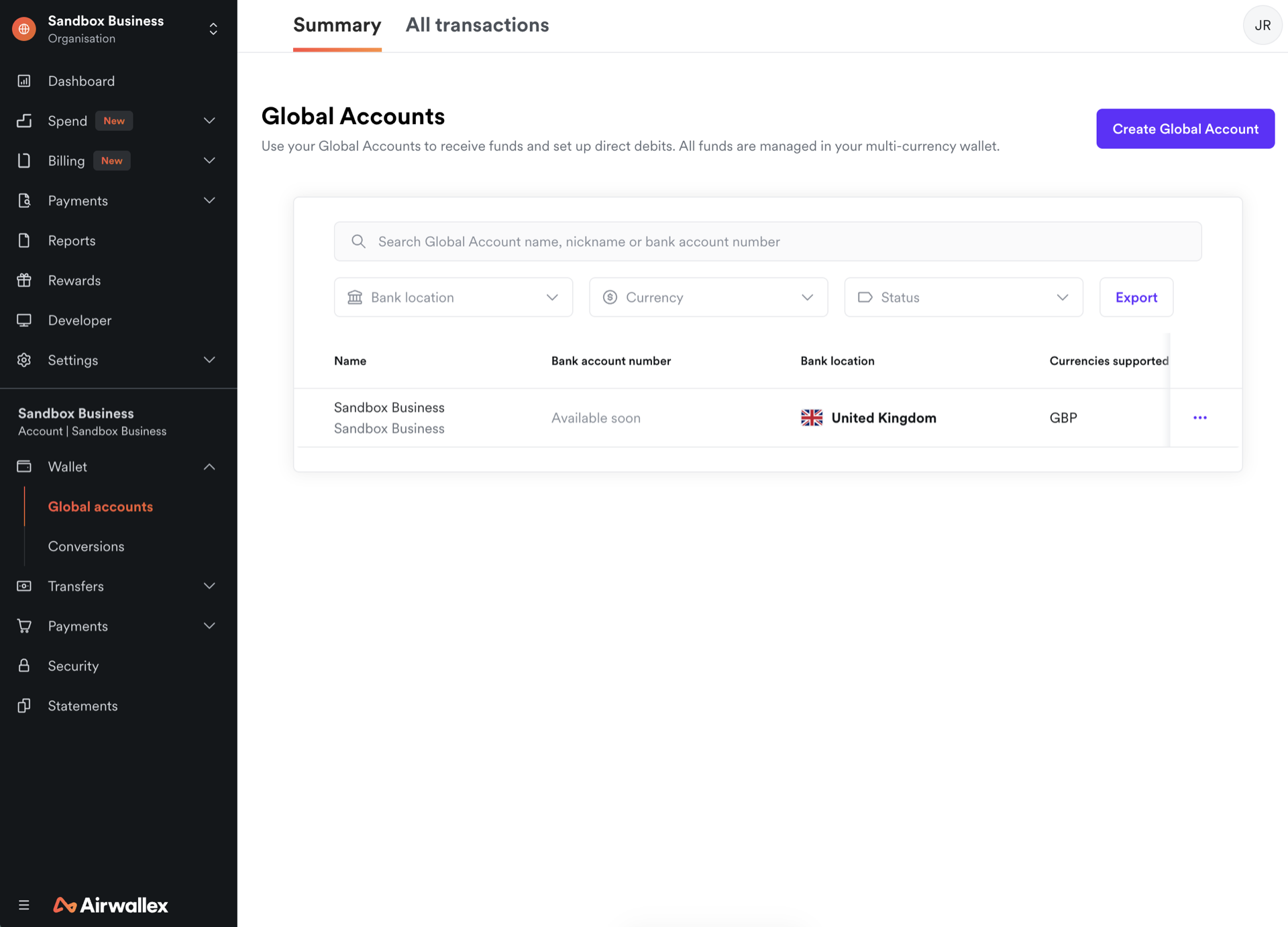
Airwallex multi-currency accounts
This is what Airwallex was built for. You get local account details in 20-plus currencies: a UK sort code for pounds, a US routing number for dollars, an IBAN for euros, a BSB for Australian dollars.
A US customer pays into your Airwallex dollar account as if it were a US bank. You hold the balance and convert to pounds at 0.5% when the rate suits, with no forced conversion on payout day.
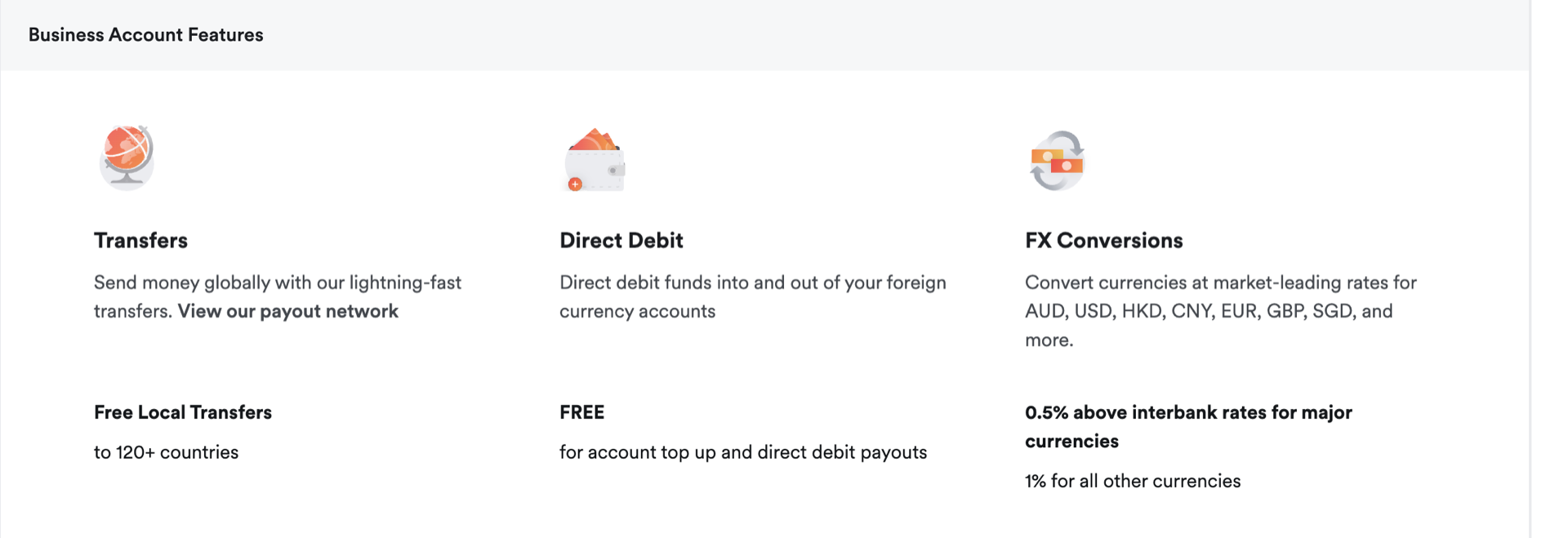
Batch payments let you pay 20 overseas suppliers across several currencies in one operation. Stripe has no built-in equivalent for that workflow.
If you sell on Amazon or Etsy, you can route dollar proceeds into your Airwallex dollar account and skip the forced conversion marketplace and high-street-bank FX rates impose.
Stripe multi-currency settlement
Stripe accepts payments in 135-plus currencies. By default a UK merchant’s funds convert to pounds before they reach the bank, but Stripe’s multi-currency settlement lets you hold balances and take payouts in up to 18 currencies, as long as you add a bank account in each one.
The 2.0% conversion surcharge applies whenever the payment currency differs from your settlement currency. Settle in euros instead and Stripe charges nothing; most other currencies, US dollars included, cost 1%.
Stripe has no batch supplier-payment tool either. To pay overseas contractors you reach for Wise Business or a bank wire on the side, which is a second system.
Where Stripe pulls ahead is tax: Stripe Tax automates VAT and sales-tax calculation across jurisdictions, a real advantage if you sell into many countries and would otherwise pay an accountant to file in each.
Quantified savings
Take a UK e-commerce business at £200,000 a year, 40% of it EU buyers, so around £80,000 in euros. On Stripe that EU slice costs roughly £3,600 a year if you take it as pounds: 2.5% on the EEA cards and 2.0% to convert the euros.
On Airwallex the same slice costs around £2,320: 2.40% on the cards and 0.5% on the FX. That is about £1,280 a year saved, most of it on currency. We derived both from the providers’ pricing pages on 5 October 2026.
Now take a UK importer paying Chinese suppliers £50,000 a year in foreign invoices. Airwallex’s 0.5% margin against a typical bank rate of 2 to 3% saves £750 to £1,250 a year, with only a £10 to £20 SWIFT fee per transfer on top.
On cross-border volume of £50,000 to £100,000 a year, the FX saving usually recovers a simple switch inside the first year.
Downsides of Stripe and Airwallex
Downsides of Stripe
Stripe’s 2.0% conversion surcharge is now four times Airwallex’s 0.5%. At £200,000 of cross-border volume a year, that gap is a four-figure cost you carry every year you do not switch.
Stripe converts foreign receipts to pounds by default. You can hold dollars or euros only through its multi-currency settlement, which needs a bank account in each currency and charges 1% for most currencies other than euros.
The automated risk systems can hold or close accounts for unusual patterns or high-risk adjacency. Trustpilot and merchant forums show freezes as a recurring theme. If you sit near a grey category, plan for it.
And standard-tier accounts get no named account manager. You email, and you wait.
Downsides of Airwallex
Airwallex’s subscription portal is the clearest remaining gap. Dunning, proration and metered billing are all there now, but the hosted customer self-service portal is still on the roadmap, so subscribers cannot yet manage plans themselves out of the box.
The developer ecosystem is smaller than Stripe’s. Fewer pre-built integrations, fewer community answers when an engineer is stuck.
Its in-person hardware is new, launched in April 2026, so the track record, the POS integrations and the documented edge cases are thinner than Stripe’s years in the field. Confirm device pricing and availability before you commit a shop floor.
Onboarding is more document-heavy than Stripe’s, which some merchants find disruptive mid-launch. And brand recognition in UK enterprise procurement is lower; Stripe has the longer UK presence.
Alternatives to Stripe and Airwallex
Mollie
Mollie has a strong UK and EU presence and specialist cover of European local methods: iDEAL, Bancontact, SEPA Direct Debit, Klarna and more. Its UK consumer card rate is competitive at 1.20% + 20p.
It is the better pick if you run a UK e-commerce business with EU customers and want simpler EU-oriented processing without paying for Airwallex’s multi-currency infrastructure. Skip it if multi-currency accounts or APAC cover matter to you.
Wise Business
Wise Business beats Airwallex on pure FX and transfers: local accounts in several currencies and conversion at the mid-market rate plus a small upfront fee. On a clean pounds-to-euros conversion it is the cheapest you will find.
The catch is that Wise is not a card processor. You still need Stripe or another gateway to accept cards online.
The strongest combination is Wise Business for currency and supplier payments alongside Stripe for card acquiring, if you find the Airwallex all-in-one more than you need.
Shopify Payments
Shopify Payments is open only to Shopify merchants, with UK card rates from 2% + 25p on the Basic plan and no Shopify third-party fee when you use it as the primary processor.
If your store lives on Shopify it removes the gateway question entirely. Skip it if you sell outside a Shopify storefront or need serious subscription, marketplace or multi-currency tooling.

Final Verdict: Stripe or Airwallex?
Choose Stripe if your business is UK-domestic and your customers pay in pounds, and you need the deepest developer tooling, a mature marketplace product, or a ready-made subscription portal today.
Stripe’s 1.5% + 20p card rate is fair for what you get, and Connect and the billing portal are still the most mature in their categories.
Choose Airwallex if you handle real foreign currency: selling in euros or dollars, invoicing overseas, paying foreign suppliers, or holding balances against future costs.
The 0.5% FX margin against Stripe’s 2.0% surcharge, plus real local-currency accounts, saves material money. And the old catches have largely gone: Airwallex now takes payments in person, and its billing handles dunning, proration and metered usage.
The remaining trade-offs are a smaller developer ecosystem, a customer billing portal still on the roadmap, and newer in-person hardware. We rate Airwallex the stronger all-rounder for a cross-border UK business, and Stripe the safer pick for a pounds-only one that lives on its API.
Plenty of firms run both: Stripe for billing and marketplace work, Airwallex for currency and international payments. The two coexist cleanly, and you are not forced to choose.
Frequently Asked Questions
Is Airwallex cheaper than Stripe in the UK?
On UK-only card transactions, Airwallex is a little cheaper: 1.30% + 20p on Explore against Stripe’s 1.5% + 20p, roughly £1,000 a year per £500,000 of UK card volume.
On cross-border flows it is decisively cheaper. A 0.5% FX margin against Stripe’s 2.0% conversion surcharge saves around £1,200 a year per £80,000 of euro volume, before the card-rate edge.
For a low-volume UK-only merchant, the absolute difference is small and will not justify a switch on its own.
Can I use both Stripe and Airwallex?
Yes, and plenty of UK businesses do. A common setup is Stripe for UK card acquiring, subscription billing and marketplace work, with Airwallex for multi-currency accounts and the FX on EU and US sales.
The two run independently, with no technical conflict, and transfers between them are straightforward.
Which is better for subscription billing?
It is closer than it was. Airwallex Billing now handles dunning with dynamic retry schedules, proration on mid-cycle changes, and metered usage billing, the logic that used to be Stripe’s alone.
Stripe still ships a hosted customer self-service portal out of the box, where subscribers manage their own plans and cards. Airwallex has that on its roadmap but not yet live as a native feature.
So for complex billing where customers self-serve, Stripe is still the safer pick today; for everything else, the gap has largely closed.
How does multi-currency work on Airwallex?
Airwallex gives you local account details in 20-plus currencies: a UK sort code for pounds, a US routing number for dollars, an IBAN for euros, an Australian BSB, and more.
You receive in the buyer’s currency, hold the balance, and convert to pounds at 0.5% above interbank when you choose, with no forced same-day conversion.
Stripe converts to pounds at a 2.0% surcharge by default. Its multi-currency settlement can pay out in up to 18 currencies instead, free for euros and 1% for most others, but each needs its own bank account.
Does Airwallex have a card reader in the UK?
Yes, as of April 2026. Airwallex launched UK card hardware: the M90 terminal with a built-in reader and printer, plus SoftPOS to take contactless on an Android or Apple phone.
That is a change from a year ago, when Airwallex had no in-person option and you needed a second provider for the counter. What Airwallex still does not do is publish a price for the hardware, so the cost of the counter is a sales conversation rather than a figure you can compare.
Is Airwallex safe and FCA regulated?
Yes. Airwallex (UK) Limited is FCA-authorised as an electronic money institution, FRN 900876. Customer funds are safeguarded under UK EMI rules, held separately from Airwallex’s own money.
Stripe Payments UK Limited is also an FCA-authorised EMI, FRN 900461. Both safeguard funds the same way, and neither is covered by FSCS, which applies to banks.
How we reviewed this comparison
Ranking criteria. We compared Stripe and Airwallex on pricing, fees, feature set, eligibility, and contract terms. We also verified regulatory status and deposit protection where applicable.
Data sources. Every provider’s pricing page, terms, and product docs were checked directly in October 2026. No comparison sites, no press releases, no affiliate material. FCA register cross-checked for regulatory status.
Update cadence. We re-verify every provider on this page at least monthly, and whenever a provider changes pricing, eligibility, or terms. The verification date on the page reflects the most recent full review. Some links on this page are affiliate links, see our editorial policy.