Email marketing is still one of the highest-return channels a UK business has, and AI is now baked into most of the major platforms. The question is not whether to use AI in your email, but which tool’s AI will actually move the numbers on your campaigns. We weighed the four below on what their AI does in practice, not on what the marketing pages claim.
One thing to hold onto as you read: most “AI” labels here are real, but a few are old optimisation logic in new packaging.
What AI adds to email marketing
AI in email marketing works across a few layers. The most visible is content help: generating subject-line options, drafting body copy from a brief, or tightening an existing draft. Less obvious, and often more valuable, are the features running quietly in the background: send-time optimisation that predicts when each subscriber tends to open, predictive segmentation that groups contacts by likely behaviour, and automated flows that branch on what a contact does or fails to do.
Quality varies a lot between platforms. Klaviyo and ActiveCampaign run genuine predictive models; some rivals slap an “AI” badge on rules-based logic that has shipped for years. Knowing which is which changes how you read the rest of this page. We rate the predictive tools the only AI here worth paying extra for.
Mailchimp: AI features and UK suitability
Mailchimp is the most widely used email platform among UK small businesses, partly for its generous free plan and partly because it plugs into almost everything else you run. Its AI set has grown considerably since 2024.
The Content Optimizer scores your sent campaigns against industry benchmarks and flags subject-line length, image-to-text ratio, and readability problems. The Subject Line Helper generates options from your campaign content and rates each for predicted open rate. Send Time Optimisation, on paid plans, studies each subscriber’s past opens and schedules delivery for when they are most likely to engage, rather than blasting the whole list at once. When your subscriber tends to open at 9pm on a Tuesday, it learns to land your next email then.
There is also a generative tool for writing body copy on paid plans that drafts from a short description. The output is a reasonable starting point, rarely a finished one; you will still edit it before it goes out.
On price, the free plan covers 500 contacts and 1,000 sends a month. Essentials starts at approximately £10 per month for 500 contacts (billed in USD), and Send Time Optimisation needs the Standard plan from approximately £16 per month. Costs climb with your list size. Mailchimp is GDPR-compliant with consent tools built in and data handled under standard contractual clauses. We would reach for Mailchimp first if you want broad features and integrations and you are not primarily an ecommerce seller.
View Mailchimp plans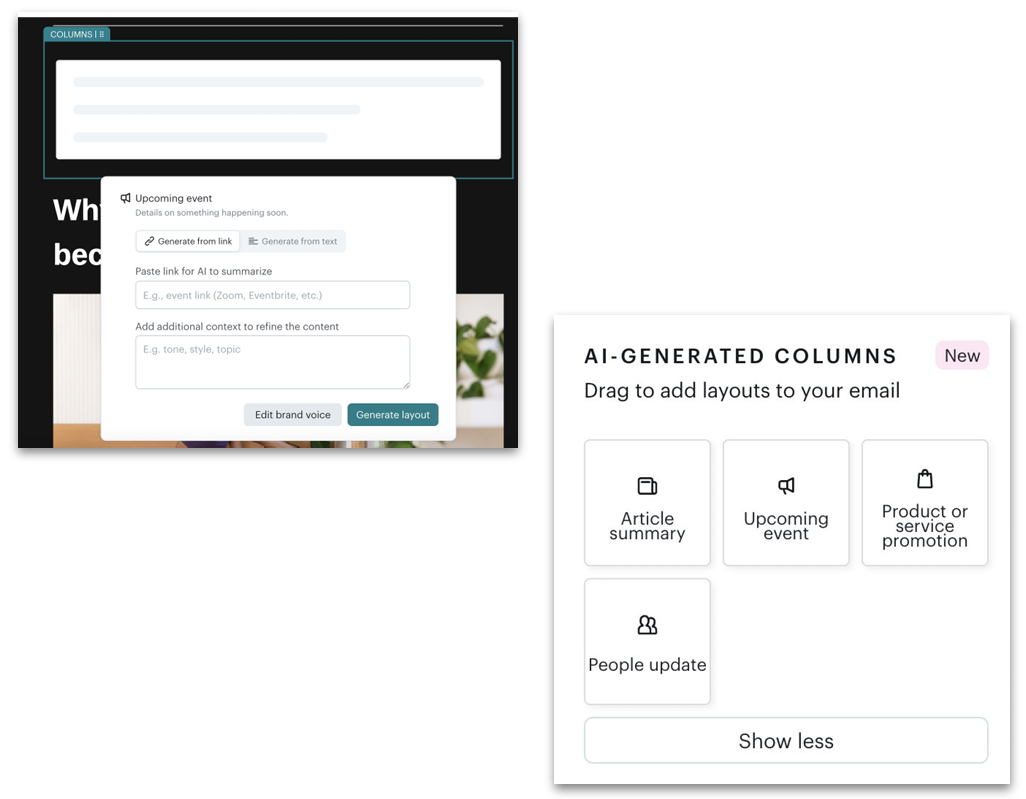
Klaviyo: AI for ecommerce email
Klaviyo is built for ecommerce and hooks deep into Shopify, WooCommerce, and the like. Its AI is organised around purchase behaviour and lifetime value, which makes it a powerful fit for online sellers and largely wasted on a service business.
Predictive Analytics is the standout. It forecasts each customer’s likely next-purchase date, predicted lifetime value, and churn risk, then hands that data to your segments. Build a segment of customers predicted to churn in the next 30 days and Klaviyo will fire a re-engagement sequence at them automatically. By the time you would have built that churn segment by hand, Klaviyo has already triggered the win-back flow for you.
It also offers AI subject lines, individual-level send-time optimisation, and a “Smart Send Time” feature much like Mailchimp’s. Its segmentation builder is more powerful than most, and the AI segment suggestions surface audiences you would not have thought to build.
On price, it is free up to 250 contacts and 500 sends a month. Paid plans start at approximately £35 per month for 1,001 to 1,500 contacts (billed in USD). The catch is the price at scale: Klaviyo climbs steeply as your list grows, well past Mailchimp at the same size. We would only pay that premium where the predictive features feed straight into revenue, which means ecommerce.
View Klaviyo plansActiveCampaign: AI-driven automation
ActiveCampaign pitches itself as a CRM and automation platform rather than a pure email tool, and its AI reflects that breadth. The automation builder is more capable than Mailchimp’s or Klaviyo’s, and the AI is woven into the workflow logic rather than bolted on the side.
Predictive Sending tunes delivery time per subscriber, like the others. Predictive Content picks from several content variations for each subscriber based on predicted preference, which is uncommon at this price. The AI Campaign Builder lets you describe a sequence in plain English and hands you back a draft workflow with suggested triggers, conditions, and copy to edit down. ActiveCampaign brands the whole AI layer as Active Intelligence, covering these features plus adaptive content blocks that adjust per recipient.
The built-in CRM is the real draw: it lets you track a contact across sales and marketing without a second tool. The trade-off is complexity. ActiveCampaign takes longer to set up than the simpler tools, and a small team can end up paying for automation depth it never touches.
On price, Starter begins at approximately £12 per month for up to 1,000 contacts (billed in USD). Plus, which unlocks most AI features including Predictive Content, is approximately £38 per month. A GDPR framework and data processing agreements are available on request. We would pick ActiveCampaign when you genuinely need CRM and marketing in one place; if you only send campaigns, it is more tool than you need.
View ActiveCampaign plansBrevo: AI email at a lower price point
Brevo, formerly Sendinblue, bundles email, SMS, and transactional email in one platform at a price that suits a tight budget. Its AI is thinner than Klaviyo’s or ActiveCampaign’s, but it has improved since the 2023 rebrand.
Send Time Optimisation is on paid plans and works on the same principle as the rest. There is an AI writing assistant for content and subject lines, and the automation builder handles basic conditional logic and behavioural triggers, though it lacks the predictive features Klaviyo and ActiveCampaign carry. The AI here is functional, not cutting-edge.
Where Brevo wins is value. Unlike Mailchimp and Klaviyo, which price by the size of your contact list, Brevo charges by the number of emails you send, so you can hold unlimited contacts without the bill climbing with them. The free plan covers 300 emails a day to an unlimited number of contacts. Paid plans start at £6 per month for 5,000 emails a month with no cap on contacts. If you are watching every pound and you can live without predictive segmentation, you get a working toolset here for less than the alternatives charge. As a French company with EU-based servers and strong GDPR documentation, Brevo also reassures UK businesses that worry about data residency.
Try Brevo freeHow these tools compare
| Tool | AI features | Best for | Starting price |
|---|---|---|---|
| Mailchimp | Subject line helper, send-time optimisation, content generation, campaign benchmarking | Small businesses wanting a broad, well-supported tool | Free; paid from approx. £10/month |
| Klaviyo | Predictive analytics, churn prediction, individual-level send-time optimisation, AI segmentation | Ecommerce businesses on Shopify or WooCommerce | Free; paid from approx. £35/month |
| ActiveCampaign | Predictive sending, predictive content, AI workflow builder, CRM integration | Businesses needing combined CRM and marketing automation | From approx. £12/month |
| Brevo | Send-time optimisation, AI writing assistant, basic automation | Budget-conscious businesses; charges by emails sent, not contacts | Free; paid from £6/month |
What to look for when choosing
- Match the tool to your business model: Klaviyo is built for ecommerce and its AI assumes purchase data. For a service business, Mailchimp or ActiveCampaign will fit better.
- Check what is gated behind paid plans: send-time optimisation and predictive features are often locked to mid-tier plans. Confirm what you actually get before you sign up.
- Watch your list size and growth: pricing scales with contact count for most platforms, and that scaling is where the real cost lives. Run the numbers at your projected list in 12 months, not today’s.
- Test integrations with your existing tools: if you run a CRM, ecommerce platform, or website builder, check native integration quality first. An AI feature is only as good as the data it can see.
- Review GDPR documentation: any data processor needs an adequate data processing agreement. All four offer one, but how easily you can get hold of it varies.
Final verdict
The right choice comes down to your business type, list size, and how much AI complexity you actually need.
For most UK small businesses starting out, Mailchimp is the natural first port of call. The free plan is the most generous, the documentation is extensive, and the integration library is unmatched. Upgrade to Standard once your list outgrows 500 contacts and you want send-time optimisation.
For ecommerce sellers on Shopify or WooCommerce, Klaviyo is the tool worth the premium. The predictive analytics and churn modelling are genuine revenue levers, not marketing copy. If you sell physical products online and you are not already using it, you are leaving money on the table.
For businesses that need CRM and email in one place, ActiveCampaign is the answer. The AI workflow builder and predictive content features are legitimately useful for businesses running complex multi-step sequences. Do not buy it for simple newsletters: the complexity will cost you more time than the AI saves.
For tight budgets and high-volume sending, Brevo is the standout. Unlimited contacts on every plan, EU data hosting, and a price that does not penalise you for growing your list make it the most cost-efficient choice for UK businesses that want a working email stack without the enterprise bill.
Frequently asked questions
Do AI email tools actually improve open rates?
Send-time optimisation and subject-line testing have documented effects on open rates, though results swing with industry and list quality. Klaviyo’s own published data puts the send-time uplift at 20–30% on average across its customer base, but that is an aggregate and your results will differ. The steadier benefit is consistency: AI-assisted tools stop you making the avoidable subject-line, timing, and segmentation mistakes that quietly drag performance down.
Can AI write email campaigns from scratch?
Today’s in-platform AI writers produce a serviceable first draft from a brief, but the output needs editing for brand voice, accuracy, and tone before it ships. Treat them as a cure for the blank page, not a source of finished copy. For anything brand-sensitive or compliance-relevant, read every AI-generated line before you send.
Which tool is best for a UK business just getting started?
Mailchimp is the usual starting point for its free plan, big template library, and deep documentation. Brevo is worth a look if cost is your main constraint, since its free plan allows more volume. Both are GDPR-compliant and integrate with most UK ecommerce and website platforms.
How we assessed these tools
We reviewed these platforms against four criteria that matter most to UK businesses choosing an email marketing tool.
AI feature depth and honesty. We assessed whether each platform’s AI features are genuinely predictive (running statistical models on behavioural data) or rules-based logic relabelled for 2024. We drew on publicly available product documentation, published research from each provider, and independent user reviews on G2 and Capterra, filtering specifically for reviews that referenced AI feature performance rather than general usability.
UK GDPR and data handling. We reviewed each platform’s data processing agreement, the location of data processing infrastructure, and their approach to consent management and data subject rights. EU-based data processing (as with Brevo) received credit where UK businesses face questions about transatlantic data transfers. All four platforms offer DPAs; availability and specificity vary.
Pricing structure and true cost at scale. We used each provider’s UK-facing or global pricing pages as of July 2026. USD-denominated prices are converted to approximate GBP equivalents at the prevailing rate; the exact GBP charge will depend on your payment method and exchange rate at the time of billing. For list-based pricing models, we modelled costs at 500, 2,000, and 10,000 contacts to show how bills scale.
Integration and ease of adoption. We assessed native integration quality with the tools UK SMEs most commonly run alongside email: Shopify, WooCommerce, HubSpot, Salesforce, and major website builders. Complexity of setup was also a factor: a powerful tool that takes three weeks to configure is not an equivalent option to one you can send from in an afternoon.
We did not accept payment, free access, or any other consideration from any of the providers listed in exchange for coverage or placement. Our affiliate link for Brevo does not influence its assessment, ranking, or editorial coverage.
Affiliate disclosure: This page contains one affiliate link: the Brevo links are affiliate links (marked with a sponsored attribute), and BusinessExpert earns a commission if you sign up via those links. We do not have affiliate arrangements with Mailchimp, Klaviyo, or ActiveCampaign; those links are included on editorial merit only. Affiliate status has no bearing on any tool’s assessment or ranking on this page.