




Which Is Better for international payments?
For international payments, the winner depends on volume. Revolut wins for most SMEs sending occasional cross-border transfers. Airwallex wins once your business clears £10,000 a month in deposits and starts paying multiple suppliers abroad in bulk.
Revolut Basic gives you 25+ currency wallets and near-interbank FX inside the plan allowance. Invoice in dollars, send a euro payment to a Lisbon contractor, hold incoming USD to convert later: all of it sits inside the £10 a month. Airwallex asks £19 for the same use case.
Airwallex flips the maths once volume scales. The £19 fee waives at £10,000 monthly deposits, and batch payouts push fifty supplier payments through one CSV. If you run a marketplace or agency with regular international payouts, that workflow is worth the £19.
For most incorporated readers landing on this page, the answer is Revolut. A £10 a month entry plan, broader SME tooling, FSCS cover on new accounts. Switch to Airwallex only if your operational pattern matches the volume profile.
We say incorporated deliberately. Revolut’s own pages disagree on whether it takes UK sole traders, so if you trade in your own name you cannot plan around either answer.
Revolut vs Airwallex Fees and Charges
Revolut Basic is £10 a month, flat, with no annual discount. Grow is £35 a month billed monthly, or £30 a month if you pay for the year up front. Scale is £125 monthly, or £90 a month billed annually. The higher tiers mostly buy bigger FX and transfer allowances.
Both figures matter, and we quote both for a reason. Budget off the £90 annual-equivalent for Scale while you are actually billed monthly and you are £420 down over a year. Priced as a discount, felt as a sting when the direct debit lands.
Stay inside the Basic plan’s limits and the only other cost most readers meet is FX, once the monthly allowance runs out.
Airwallex Explore is £19 a month, billed flat. Deposit £10,000 or more in a calendar month and the fee is waived. Drop below that for one quiet August and the £19 bites. Airwallex calls Explore its “starter plan”. Translated: you’re paying a volume threshold dressed up as a monthly fee.
Both providers charge above-allowance FX as a small percentage spread, and both charge on out-of-allowance international transfers. Neither charges you for incoming international payments in the relevant currency. We checked Airwallex’s fees on its live pricing page in October 2026, and Revolut’s on its own pricing pages in July 2026.
If you are a UK sole trader, neither of these is really aimed at you. Revolut cannot tell you where you stand, because its Help Centre lists sole traders as unsupported while its Business Terms, effective 28 April 2026, include new sole traders. Airwallex charges the £19 whether or not your quiet August clears £10,000.
Look at Wise for cheap one-off transfers at the mid-market rate, Starling or Tide for a free sole trader current account, or Revolut Pro inside the personal app if you want Revolut’s FX without the company.
| Cost | Revolut Basic | Revolut Grow | Airwallex Explore |
|---|---|---|---|
| Monthly fee | £10 flat | £35 billed monthly, or £30/mo if paid annually (£360/yr) | £19 (free with £10k+ monthly deposits) |
| International transfer (within allowance) | Free | Free | Free |
| International transfer (above allowance) | Fees apply | Fees apply | Fees apply |
| Multi-currency accounts | Yes | Yes | Yes (20+ currencies) |
| FSCS protection | Yes, on deposits held by Revolut Bank UK Ltd (PRA-authorised 11 Mar 2026)* | Yes, on deposits held by Revolut Bank UK Ltd* | No (e-money) |
| *Revolut says the migration to its bank entity is complete, and transitions any account opened on Revolut Ltd automatically; your statement names which entity holds your account. Representative costs verified from provider websites; Revolut plan pricing re-verified against revolut.com/business, July 2026. | |||
Revolut vs Airwallex Features and Tools
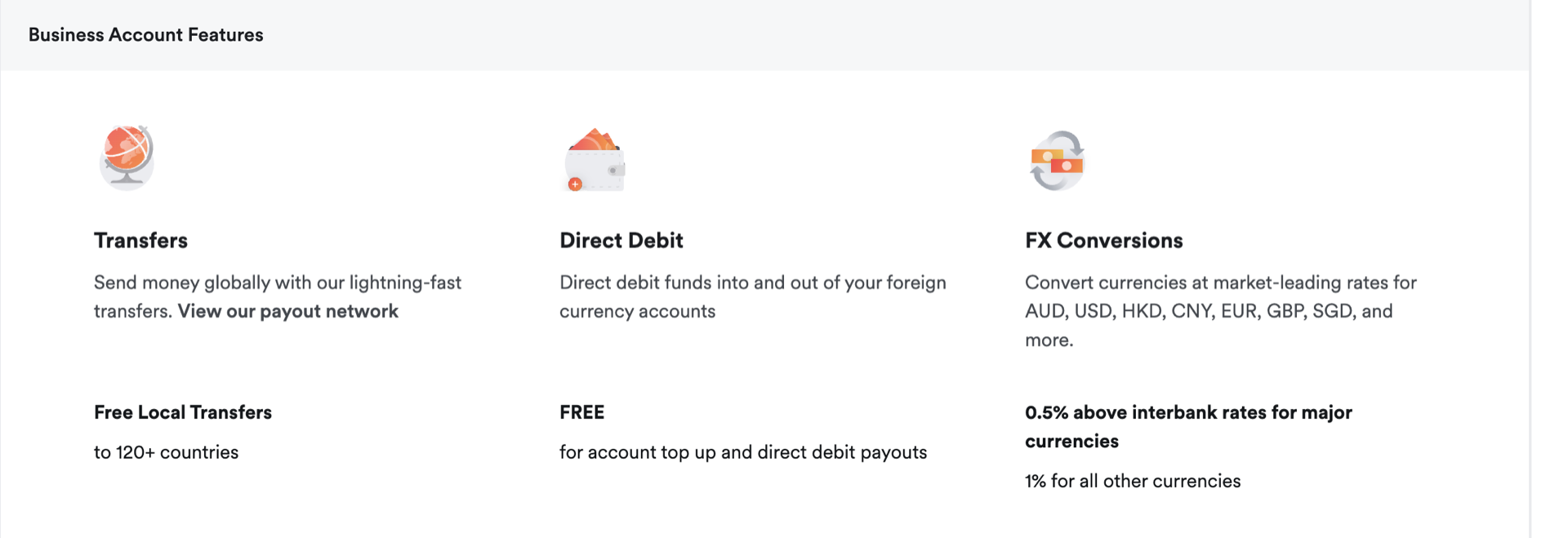
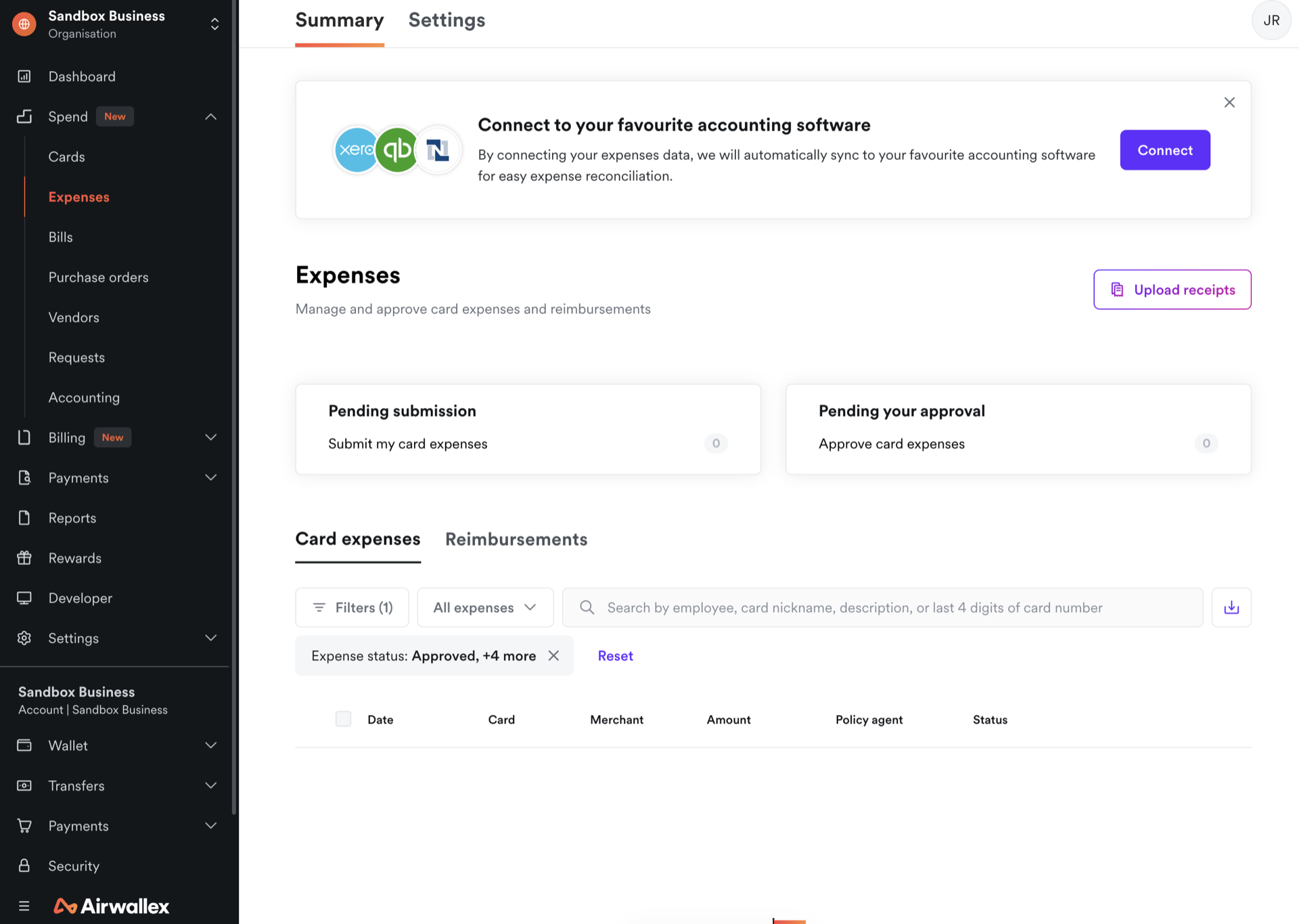
Beyond pricing, the two accounts diverge most on SME tooling. Revolut packs team expense cards, spend rules, virtual cards, and a FreeAgent integration into Basic. Airwallex Explore strips most of that back, its kit is built around payouts, not team operations.
Revolut connects to Xero, QuickBooks, and FreeAgent. Those are the three packages most UK SMEs actually use. Airwallex connects to NetSuite, which matters if your finance team is on enterprise-grade software but is overkill for a five-person business.
For team cards, Revolut wins outright. You can issue virtual or physical cards to staff, set per-card spend limits, restrict merchant categories, and pull receipts into the app. Airwallex offers borderless cards, but the team controls and spend-rule depth aren’t at parity.
Both offer GBP account numbers and sort codes, both support Direct Debit setup, both have mobile apps that don’t make you want to throw the phone across the room. Revolut’s app is the more polished of the two, Airwallex feels more like a back-office tool than a daily-use account.
Revolut vs Airwallex International Payments
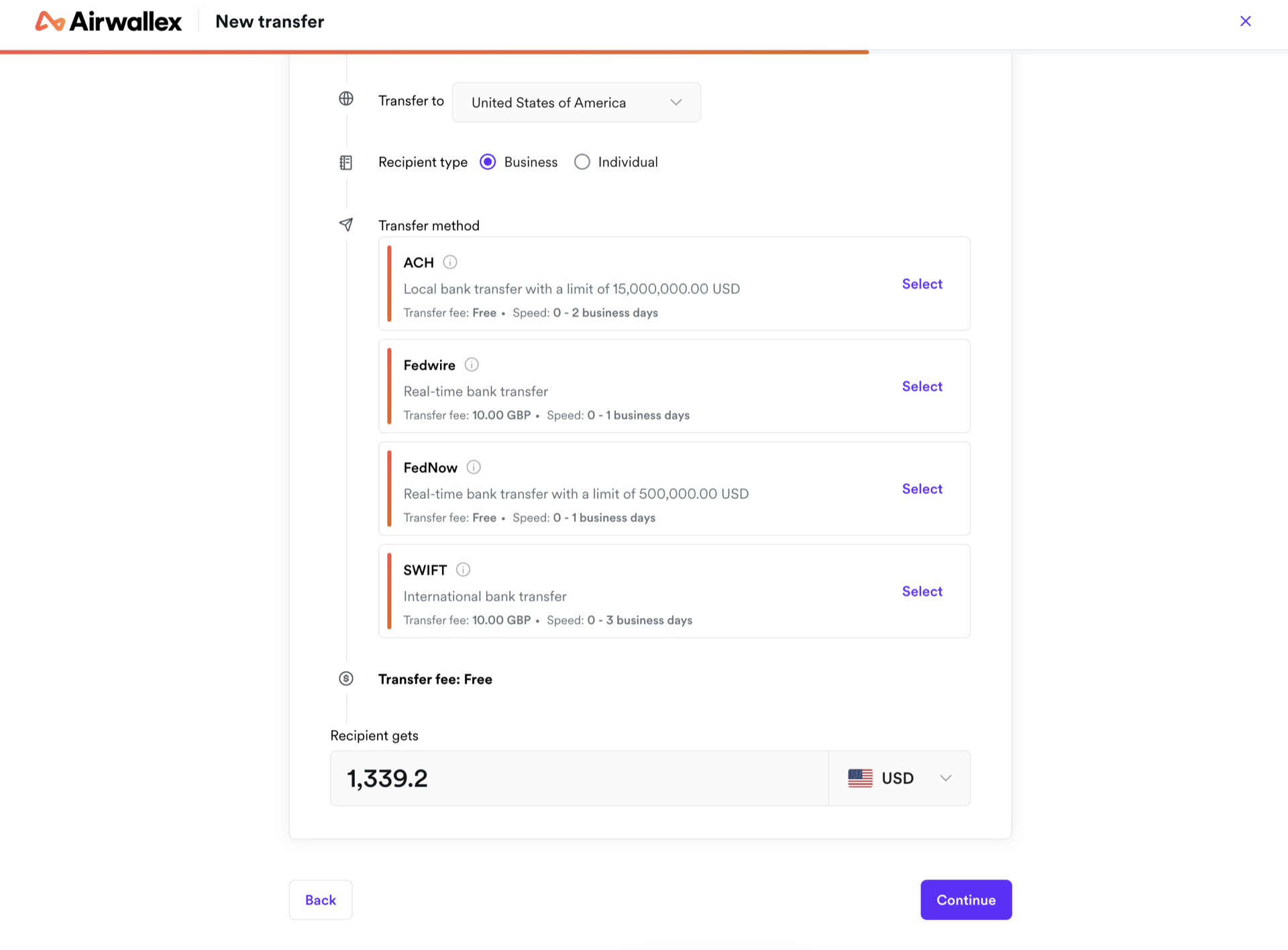
Invoice in dollars on Tuesday and the payment lands on Friday afternoon; both accounts let you hold the USD rather than convert it the moment the rate turns against you.
The split shows up at volume: Airwallex routes bulk supplier and contractor payouts in one batch, where Revolut sends transfers one at a time. That’s where Airwallex wins.
On the protection side, the regulator behind the account matters more than the app. The PRA lifted the mobilisation restrictions on Revolut’s licence on 11 March 2026, turning a restricted bank into a fully authorised one.
Which entity your account sits on decides whether that cover is real. Revolut is onboarding new applicants to the bank in batches, so a minority of recent signups are still parked on the e-money entity. Airwallex stays an FCA e-money institution, safeguarded but never FSCS-covered.
If an e-money firm fails, you join a creditor pool against the safeguarded balance and wait your turn. FSCS works nothing like that: it pays most depositors automatically within seven working days, no claim form, nobody to chase. For most UK SMEs, that difference matters.
Revolut vs Airwallex Customer Reviews and Reputation
When we checked Trustpilot in May 2026, Revolut Business sat at around 4.2 stars across 200,000+ reviews. Airwallex sat lower at around 3.9 stars across a much smaller review base. Neither score is brilliant; neither is a red flag.
The themes are familiar. Revolut customers praise the speed of FX, the app polish, and the breadth of features for the price.
Complaints cluster around account freezes during compliance reviews, a known fintech onboarding issue where a flagged transaction can lock the account for days while support catches up.
Airwallex reviews skew toward operations teams who like the batch tooling and the NetSuite link. Complaints lean the other way: smaller users feel ignored, support response times are slower than Revolut’s in-app chat, and the product clearly isn’t designed for someone running a side hustle.
For support quality, Revolut has 24/7 in-app chat that responds in minutes for most queries. Airwallex offers email and chat during business hours, with priority routing for higher-tier customers. If you’re on the SME tier and something goes wrong at 9pm, Revolut will pick up first.
Revolut vs Airwallex for High-Volume International Payments
If your business is built around high-volume international payments, the comparison flips. Airwallex was engineered for this pattern; Revolut is multi-currency-capable rather than payout-optimised, and the gap shows the moment you are paying more than a handful of people at once.
The batch payment workflow is the clearest differentiator. Airwallex lets you upload a CSV, fifty rows, six currencies, one click, and routes the lot. Revolut sends transfers one at a time. For a finance team paying 200 contractors a month, that’s an afternoon versus a week.
Airwallex’s payout API matters at the volume level too. Marketplaces, creator platforms, and agencies pushing payouts to many recipients each month can wire the API into their internal systems. Revolut Business doesn’t expose an equivalent payout API on its SME tiers.
FX above the plan allowance is where Revolut’s pricing starts to bite at volume. Above £1,000 of monthly FX on Basic, the percentage spread adds up. Airwallex’s pricing is flatter at scale, if your monthly FX clears £50,000 routinely, run a side-by-side cost test before committing.
Downsides of Revolut and Airwallex
Start with the one you cannot resolve. Revolut Business accepts limited companies, LLPs and partnerships without argument, but its published material contradicts itself on sole traders, so an unincorporated applicant has no way to know before applying. Revolut Pro in the personal app is where it points unincorporated individuals.
The next weakness is the account freeze risk. The compliance engine flags a transaction and the account can lock for 24 to 72 hours. For a director waiting on one invoice, that is survivable. For a company with weekly payroll, it is a real operational risk.
Revolut also has no overdraft on the Business product. If your cash flow dips into the red at month-end, you’ll need a separate credit line or a high-street account alongside. We checked both providers’ product pages for any overdraft or credit facility in May 2026 and found none.
Airwallex doesn’t offer overdraft either. Neither provider replaces a traditional bank for working capital lending.
Airwallex’s biggest weakness is the £19/month fee at low volume. If your deposits are seasonal or sub-£10k, you’re paying a meaningful fee for an account that’s clearly not designed for your size. Sole traders and freelancers should look elsewhere.
Airwallex also has weaker SME tooling than its price suggests. Team cards, spend controls, and accounting integrations are thinner than Revolut’s. If you want one account that handles team expenses, FX, and accounting all in one, Revolut covers more ground for less money.
Neither provider is a perfect substitute for a high-street business bank. No physical branches, no relationship managers in the traditional sense, no cheque deposits, limited cash handling. If your business needs any of those, pair either account with a Lloyds, Barclays, or NatWest current account.
Alternatives to Revolut and Airwallex
Both Revolut and Airwallex are worth considering, but they’re not the only options. Here are the four alternatives we’d weigh first depending on your priorities:
Wise Business, cheaper for one-off FX transfers at the mid-market rate. No monthly fee, pay per transfer. Pick this if your international flow is occasional rather than constant.
Starling Business, UK-only, FSCS-protected, free monthly account with a high-street feel. Pick this if you don’t need multi-currency wallets and want a conservative banking relationship.
Tide, free UK business account with invoicing, expense cards, and accounting integrations built in. Pick this for a UK-focused SME that values invoicing tools over international features.
Mettle by NatWest, free sole-trader and limited company account from a high-street bank. Pick this if you want NatWest’s backing without the legacy bank fees.
Final Verdict: Revolut or Airwallex?
For most UK SMEs, Revolut is the better account. A £10/month entry plan, FSCS cover on new accounts, broader SME tooling, and a daily-use app that doesn’t feel like a back-office system. Airwallex only makes sense when volume justifies the £19 fee and the batch tooling.
Choose Revolut if you want one account that doubles as your day-to-day GBP bank and your international wallet, without a deposit floor.
New customers get FSCS cover to £120,000 where the account sits with Revolut Bank UK Ltd. Some businesses that applied during the phased rollout were opened with Revolut Ltd instead; Revolut says that rollout is complete and any such account transitions automatically. Revolut Basic, at £10/month, carries no £10,000 deposit hurdle.
Team expense cards, in-app spend controls, and a FreeAgent connection come in the box. When your accountant chases you for the quarter-end export at 9pm on a Sunday, you click sync instead of spending the morning building a CSV. For most SMEs, that workflow saving is what decides it.
Choose Airwallex if your business clears £10,000 of deposits a month and you spend Friday afternoons paying twenty suppliers before they email your inbox at 6pm. The fee waiver kicks in at that threshold. The batch workflow is the part Revolut doesn’t match on its SME tier.
If your finance team runs NetSuite, the native integration removes manual exports between your accounting system and the payment platform.
Revolut doesn’t connect to NetSuite, which is a genuine problem for an enterprise-grade finance stack. E-commerce marketplaces paying out to many recipients each month fit Airwallex’s wiring too.
Frequently Asked Questions
Can a UK sole trader open a Revolut Business account?
Revolut’s own material does not agree with itself, so we cannot give you a straight yes or no. Its Help Centre lists “Freelancer or soletrader” under unsupported business types, while its Revolut Bank UK Business Terms, effective 28 April 2026, list “new sole traders” among those who can open a Business Account. We read both directly and found no definitive answer, and the dates do not settle it. Limited companies, LLPs and partnerships are eligible either way. Revolut Pro, inside the personal app with no subscription fee, is where Revolut points unincorporated individuals. Airwallex will take a sole trader, but its £19 a month only disappears above £10,000 of monthly deposits, which is a threshold most sole traders will not hit every month.
How much does Revolut Business cost per month?
Basic is £10 a month, flat, with no annual discount. Grow is £35 a month billed monthly, or an effective £30 a month (£360 a year) if you pay for the year up front. Scale is £125 a month billed monthly, or an effective £90 a month (£1,080 a year) paid annually. The annual-equivalent numbers are the ones you see quoted most often, and they are the ones that catch people out: budget £90 for Scale while you are billed monthly and you will be £420 short across the year. We re-verified both billing bases against Revolut’s published plan and fee pages in July 2026.
Which has better FX rates: Revolut or Airwallex?
Both Revolut and Airwallex offer rates close to the interbank mid-market rate. Revolut uses the interbank rate within its monthly allowance, with a small fee above that. Airwallex charges a small percentage on FX conversions. The rate quality is broadly comparable for most currency pairs. For specific currencies or high-volume conversions, run a test transaction on each platform and compare the quoted rate before committing. We verified both fee structures from their published pricing in October 2026.
Can you use both Revolut and Airwallex simultaneously?
Yes. There is no restriction on holding accounts with both providers. Some businesses use Revolut for team expense management and domestic multi-currency needs, and Airwallex for batch international supplier payments. Both can be run simultaneously. You would need to manage two sets of account reconciliation, but many treasury and finance teams do this routinely.
Does Airwallex or Revolut offer a UK business current account?
Revolut Bank UK Ltd launched as a fully authorised UK bank on 11 March 2026, when the PRA lifted the mobilisation restrictions on the licence it had held since July 2024. New applicants are usually onboarded straight to the FSCS-protected bank entity, with cover up to £120,000 and the same regulatory standing as Starling or Monzo.
Some businesses that applied during the phased rollout were opened with Revolut Ltd rather than the bank. Revolut says that rollout is complete and any such account is transitioned to Revolut Bank automatically. Check the entity named on your own statement rather than assuming either way.
Airwallex remains an FCA-authorised e-money institution, not a licensed bank. It provides GBP account numbers and sort codes, but client funds are safeguarded rather than FSCS-protected.
For a primary UK current account with FSCS cover and client-facing credibility, Revolut now qualifies for most new customers, though neither provider offers an overdraft. Airwallex is better positioned as a specialist international payment platform alongside a primary bank.
Is Airwallex safe without FSCS protection?
Airwallex is FCA-authorised as an electronic money institution and is required to safeguard client funds in segregated accounts at regulated banks. That is not the same as FSCS cover. If Airwallex were to fail, you would claim against the safeguarded pool and bide your time while administrators unpick who is owed what. With an FSCS-covered bank, most depositors are paid automatically within seven working days and never fill in a form; only complex cases, such as a temporary high balance, take longer and need an application form. For working capital above a few thousand pounds, an FSCS-covered account (such as Revolut, Starling, or any high-street business account) is the more protective primary option.
How we reviewed Revolut vs Airwallex
Ranking criteria. We compared Revolut and Airwallex on pricing, fees, feature set, eligibility, and contract terms. We also verified regulatory status and deposit protection where applicable.
Data sources. Airwallex’s pricing, safeguarding and help pages were checked directly in October 2026, and Revolut’s pricing pages and terms in July 2026. No comparison sites, no press releases, no affiliate material.
Revolut plan pricing (monthly-billed and annual-equivalent) was re-verified against revolut.com/business and Revolut’s published fee pages in July 2026. On UK sole-trader eligibility we read the Help Centre entity-types page and the Revolut Bank UK Business Terms (effective 28 April 2026) directly on 24 July 2026, and found them in conflict.
Update cadence. We re-verify every provider on this page at least monthly, and whenever a provider changes pricing, eligibility, or terms. The verification date on the page reflects the most recent full review. Some links on this page are affiliate links, see our editorial policy.
Related Pages
Need to compare more international or multi-currency accounts? We have more comparisons and roundups below.
- Best international business accounts, accounts built for cross-border trading
- Wise vs Revolut, two multi-currency accounts compared
- Revolut vs Monzo, Revolut vs a digital-first UK account
- Best business bank accounts, full comparison of 15 UK providers