



London, 11/11/2025 – A new analysis of search data reveals that ChatGPT is now so dominant that it is searched more often than the word “AI” itself on Google during peak periods — an extremely rare brand-over-category event typically reserved for brands like Google and Netflix.
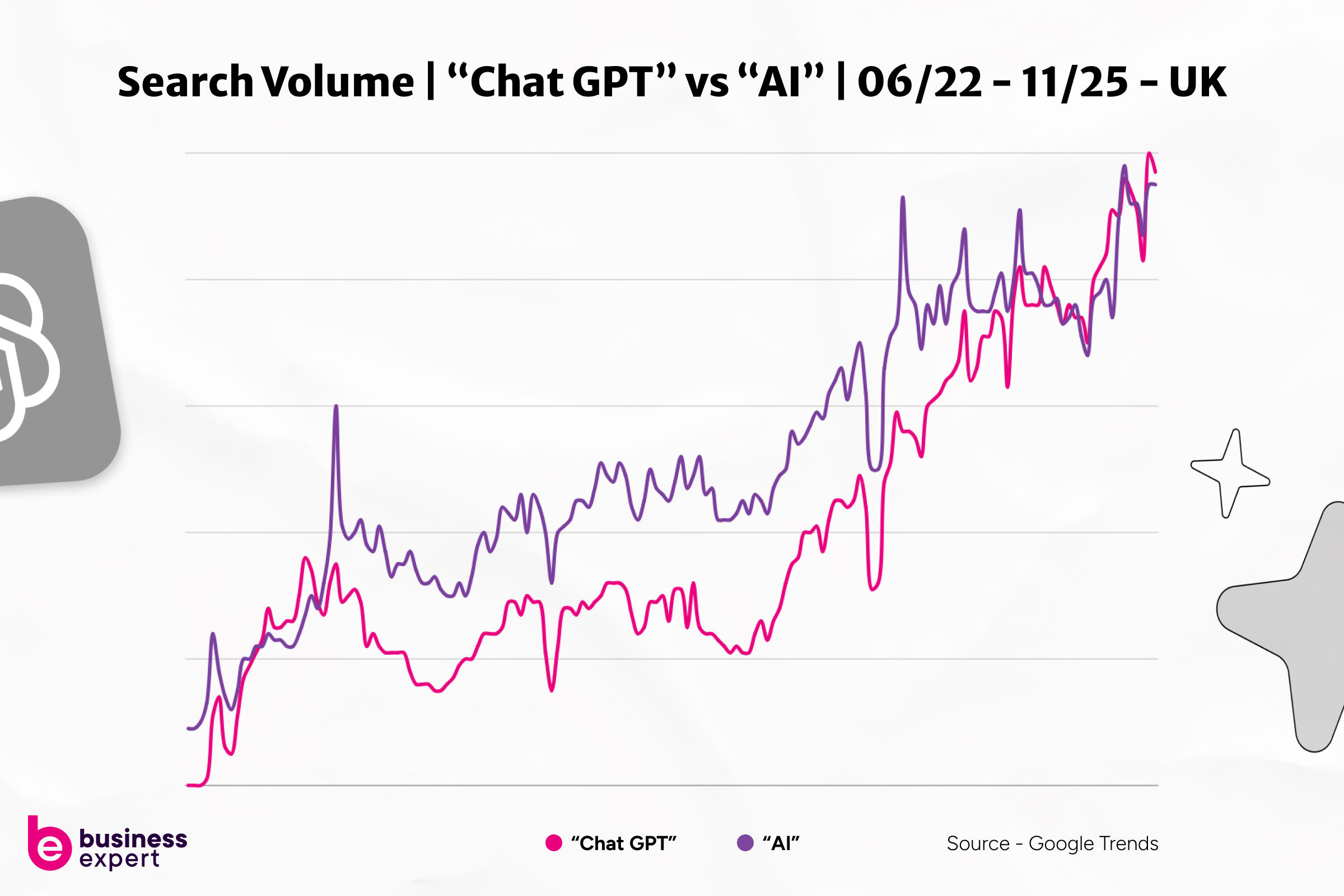
ChatGPT is still the public’s entry point into AI, but new challengers are scaling at an explosive pace — with challenger LLMs like Claude growing nearly 6× faster — rapidly narrowing the gap.
“When consumers think of AI, they don’t search for ‘AI.’ They search for ‘ChatGPT.’”
— Antony Smith, Founder, Business Expert
In multiple periods, Google Trends shows peaks where “ChatGPT” surpasses the generic term “AI” in search volume — signaling not just adoption, but cultural ownership of the category.
ChatGPT Still Dominates Public Attention
According to global search-volume data (2025–2026 projection dataset), ChatGPT attracts an estimated 15.2 million searches per month, putting it far ahead of any other AI platform.
By comparison, Microsoft Copilot receives around 641,000 monthly searches, Google Gemini about 448,000, Claude approximately 131,000, and Perplexity roughly 115,000.
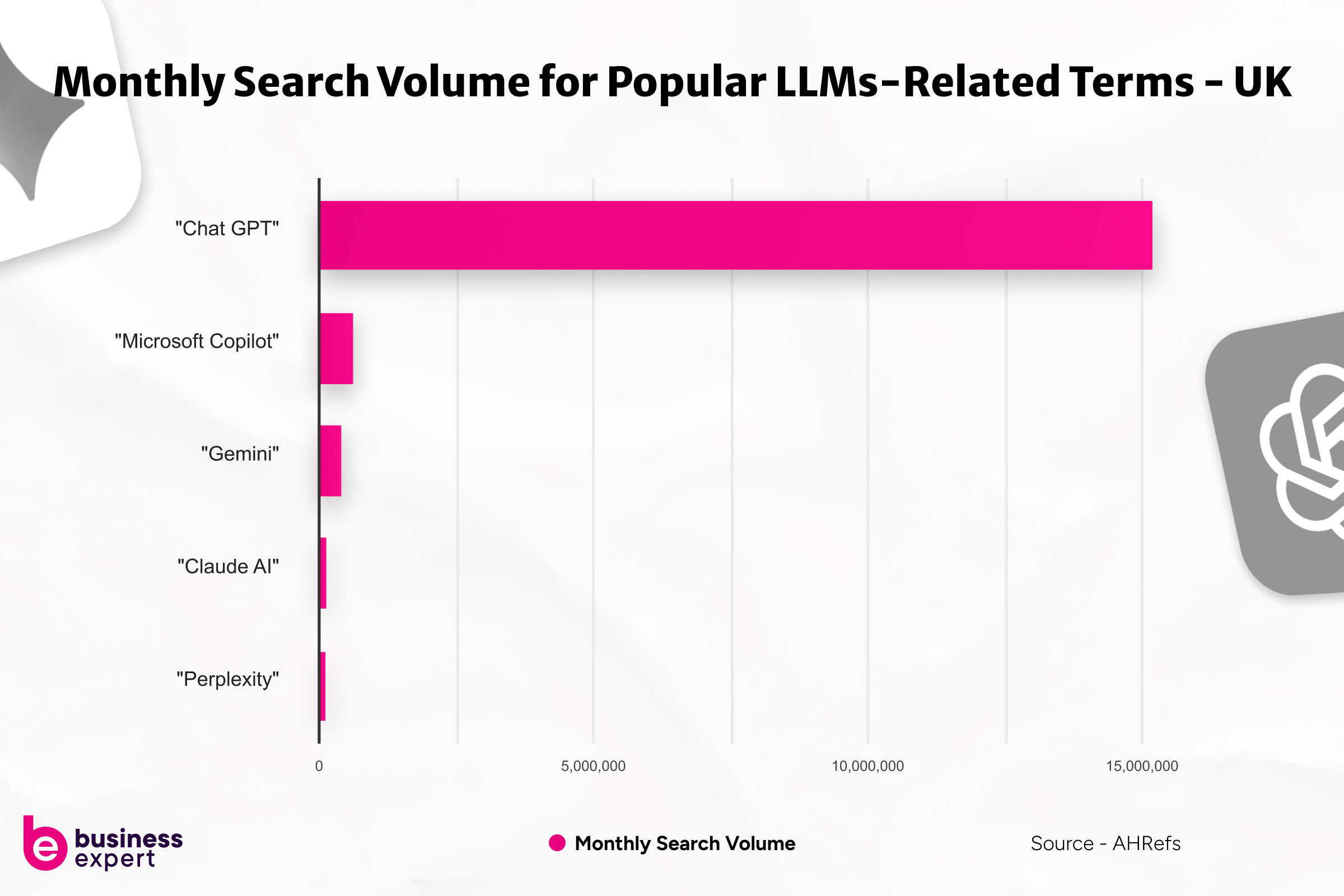
Even with rising competition, ChatGPT remains in a league of its own.
A Turning Point Year for LLM Adoption
Despite ChatGPT’s dominance in total searches, the wider landscape continues to evolve rapidly.
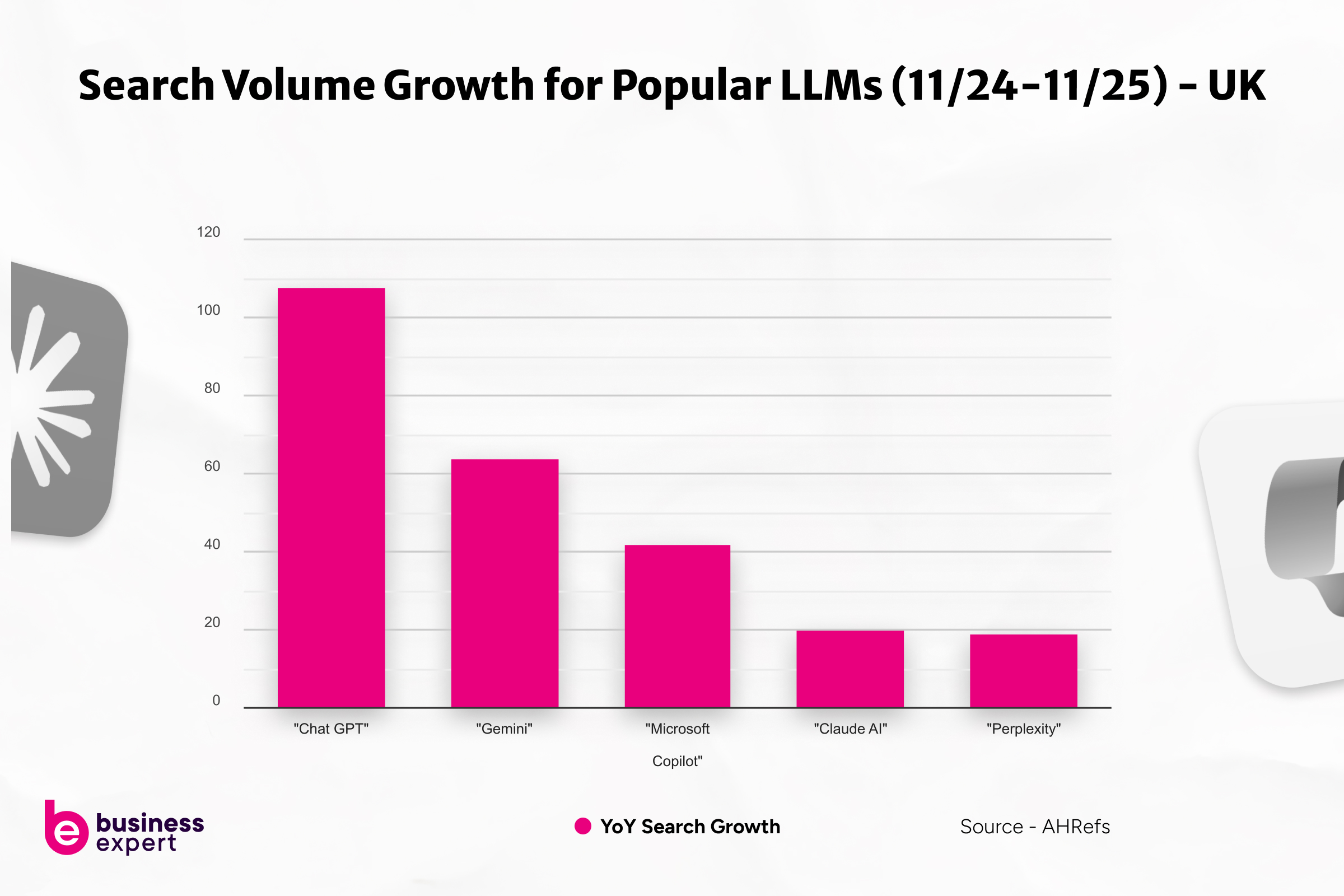
When analysing global search volumes from November 2024 to today, the data shows that established AI platforms are still expanding — though growth patterns are beginning to diverge.
- ChatGPT remains the clear leader, with search volume up 108% year-on-year.
- Microsoft Copilot continues its steady climb, increasing 42% as Microsoft deepens integration across Windows and Office.
- Gemini has grown 64% over the same period, reflecting renewed attention following product updates and rebranding efforts.
- Claude maintains moderate momentum, up 20% since late 2024.
- Perplexity, after a surge in early 2024, shows a slight 19% decline, suggesting its explosive growth phase may be stabilising.
These shifts indicate that the generative AI market is entering a consolidation phase. Users are refining their preferences, returning to a smaller number of trusted platforms while continuing to explore emerging tools.
Behaviourally, the trend remains clear: consumers are increasingly seeking answers directly from AI systems instead of traditional search engines. In 2023, 35% of chatbot users said they used them instead of a search engine (Exploding Topics, 2024).
In short, ChatGPT continues to define the category — but the race has matured into a fight for sustained engagement and ecosystem loyalty.
The LLM Market Is Entering Its High-Velocity Phase
According to Persistence Market Research (2025), the global LLM market is expected to grow from roughly $7.6 billion in 2025 to about $60 billion by 2032, reflecting a 34.6% compound annual growth rate.
Another firm, Coherent Market Insights (2025), offers a nearly identical outlook, projecting the market to rise from $8.59 billion to $67.69 billion over the same period, with a 34.3% CAGR.
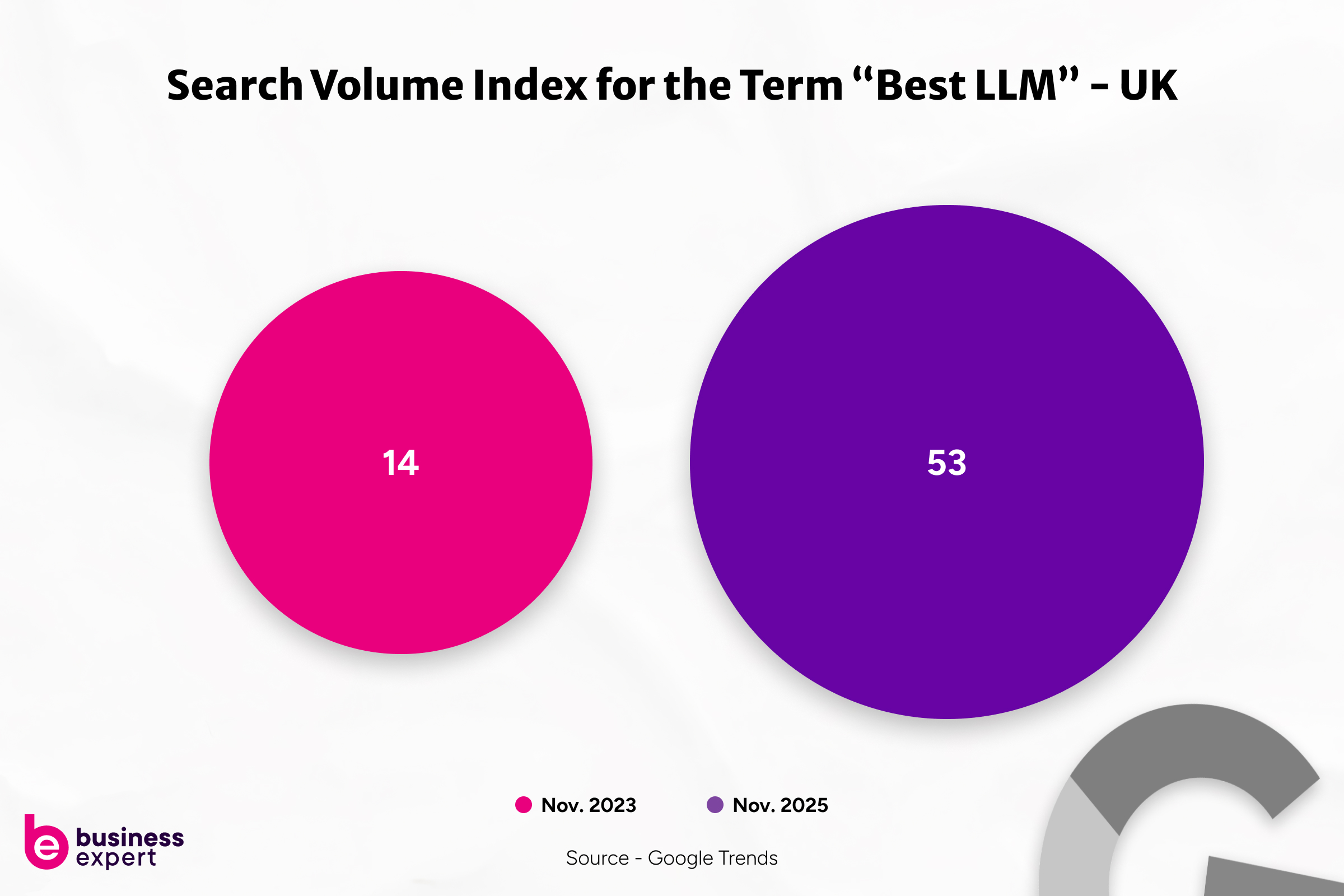
The adoption curve is now mirroring real search behaviour: consumers have shifted from asking “What is AI?” to “Which AI should I use?”.
Google Trends data reinforces this transition, showing a sharp rise in searches for terms like “best LLM” from mid-2023 onward. This signals clear purchase intent rather than simple curiosity.
Users Are Now Multihoming — Switching Between Models
As AI adoption matures, people aren’t relying on a single assistant anymore — they’re “multihoming,” switching between models based on the job to be done.
ChatGPT is still the default general-purpose assistant for many using it for writing, brainstorming, research and coding because it’s so versatile.
Alongside that, Microsoft Copilot is picked for office productivity because it’s built directly into Word, Excel, Outlook and Teams, helping users draft documents, summarise meetings and analyse data inside Microsoft 365.
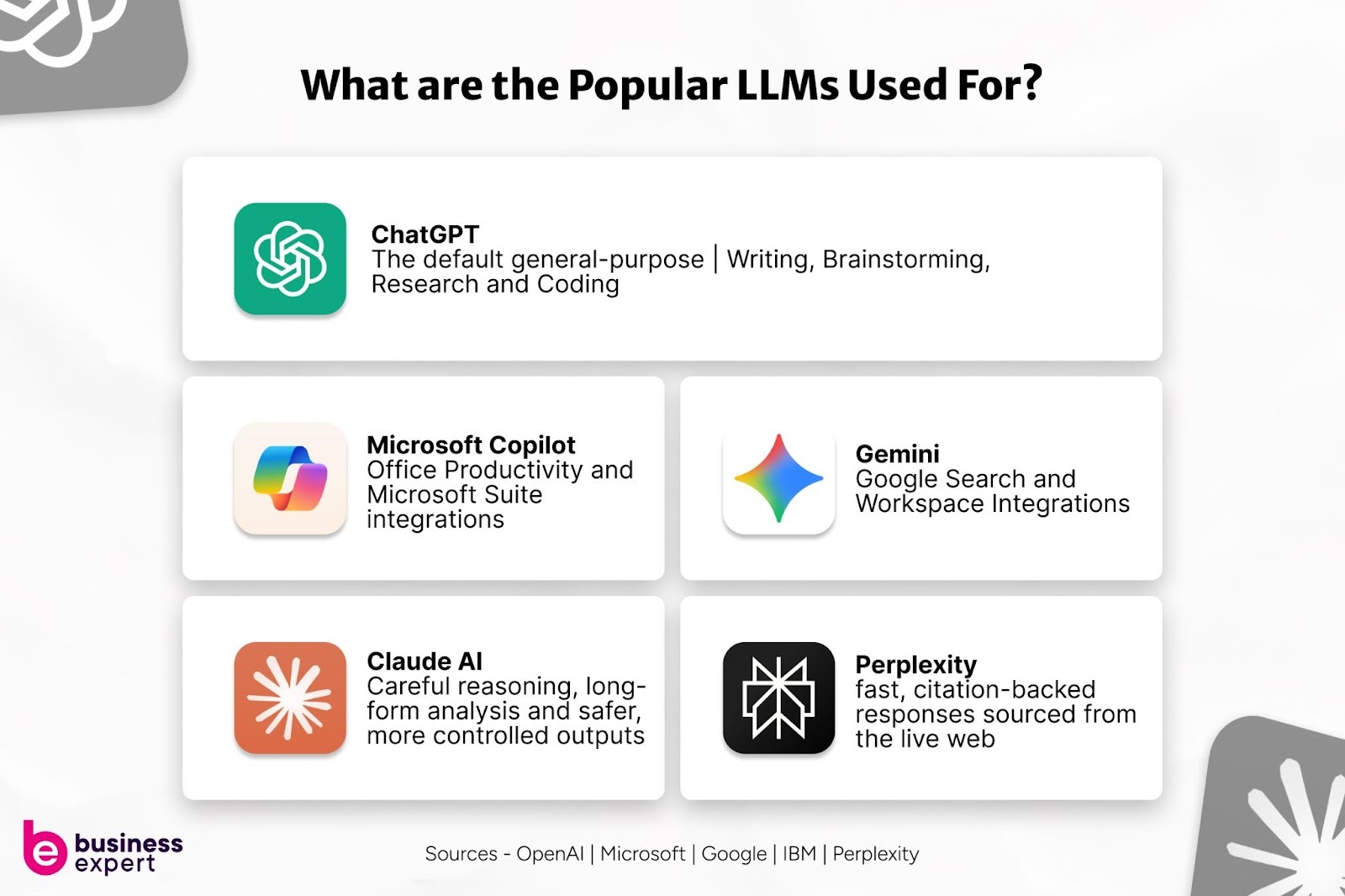
Google Gemini is chosen when people want AI tightly connected to Google Search and Workspace, with features now available across 3+ billion Android devices for email drafting, document editing and live, web-grounded answers.
Claude is often used for careful reasoning, long-form analysis and safer, more controlled outputs, which is why it’s gaining traction in enterprises that need strong governance.
Perplexity positions itself as an “answer engine,” popular with researchers and analysts for fast, citation-backed responses sourced from the live web, and now reports 10M+ monthly active users.
Together, these tools show how users now build an AI toolkit — using ChatGPT for general creativity, Copilot for office work, Gemini for Google-linked tasks, Claude for deeper analysis and Perplexity for sourced, real-time answers — and switching between them as needed.
Sources
- https://www.persistencemarketresearch.com/market-research/large-language-model-market.asp
- https://www.coherentmarketinsights.com/industry-reports/large-language-model-market
- https://explodingtopics.com/blog/chatbot-statistics
- https://www.mescomputing.com/news/ai/is-chatbot-web-traffic-beginning-to-outpace-search-engine-traffic-a-new-report-takes-a-look
- https://firstpagesage.com/reports/top-generative-ai-chatbots/
- https://arxiv.org/abs/2504.15440
- https://trends.google.com
- https://openai.com/index/how-people-are-using-chatgpt/
- https://learn.microsoft.com/en-us/copilot/microsoft-365/microsoft-365-copilot-overview
- https://blog.google/technology/ai/google-gemini-ai/
- https://www.ibm.com/think/topics/claude-ai
- https://www.perplexity.ai/hub/perplexity-2024-annual-report