

Who the Card Is Best For
- Limited companies needing a high credit limit up to £250,000, well above typical bank-card caps.
- Businesses that clear the balance monthly and never touch the high carried-balance rate.
- Companies that want cashback or Avios on everyday spend, taken as credit, gift cards or air miles.
- Businesses that spend abroad or pay overseas suppliers, with no FX or ATM fees.
- Companies that don’t want to switch business bank account, Capital on Tap doesn’t require you to move your banking to a particular provider.
Capital on Tap makes most sense for a limited company that has outgrown its bank’s card but wants to keep its existing business account. You can add borrowing capacity without rebuilding the banking setup around it.
That position is more common than it sounds. Neither Starling nor Monzo lists a business credit card among its business products, so a company banking with one and putting £12,000 a month through software, contractors and ad spend has nowhere obvious to route it. Capital on Tap doesn’t care where you bank.
You keep the account and add the card. At 1%, that £12,000 a month comes back as about £1,440 a year, provided you clear the balance.
The limit works the same way. Bank-issued business cards cap out in the low tens of thousands, and Barclaycard’s Select Cashback card, the most accessible of the traditional options, stops being the answer above roughly £15,000.
If you’re placing stock orders or funding quarterly ad spend past that, the ceiling is your constraint, not the rate.
If you carry a balance at all, none of this is the first question. The rate you’re offered is.
Eligibility and Application
| Requirement | Capital on Tap rule |
|---|---|
| Business type | Limited company, LLP or PLC |
| Sole traders | Not eligible |
| Partnerships | Not eligible |
| Turnover | Asked for during the application; no minimum published |
| Company status | Active at Companies House |
| CCJs | No unsatisfied CCJs in the last 12 months |
| Bank account | A business bank account is required; no need to switch banks or providers |
| Personal guarantee | Required from a director or major shareholder |
| Excluded types | High-risk industries, charities, trusts, dormant or dissolved companies |
| Verified 5 October 2026. | |
Who can apply. A UK limited company, LLP or PLC, active at Companies House, with no unsatisfied county court judgment in the last twelve months. Capital on Tap asks for your average monthly turnover during the application but no longer publishes a minimum. Sole traders and partnerships are excluded outright, and no amount of turnover changes that.
What the application asks for. Your details, the company’s details, average monthly turnover, and the business bank account the repayments will come from.
Income is verified through Open Banking rather than paperwork, using Plaid. You can send statements manually instead, but it slows the decision.
Timing. Capital on Tap says most applicants get a decision in under two minutes. Approval gets you a virtual card straight away and the physical card follows separately, which is the difference between useful and academic if you’re applying because a supplier payment is already due.
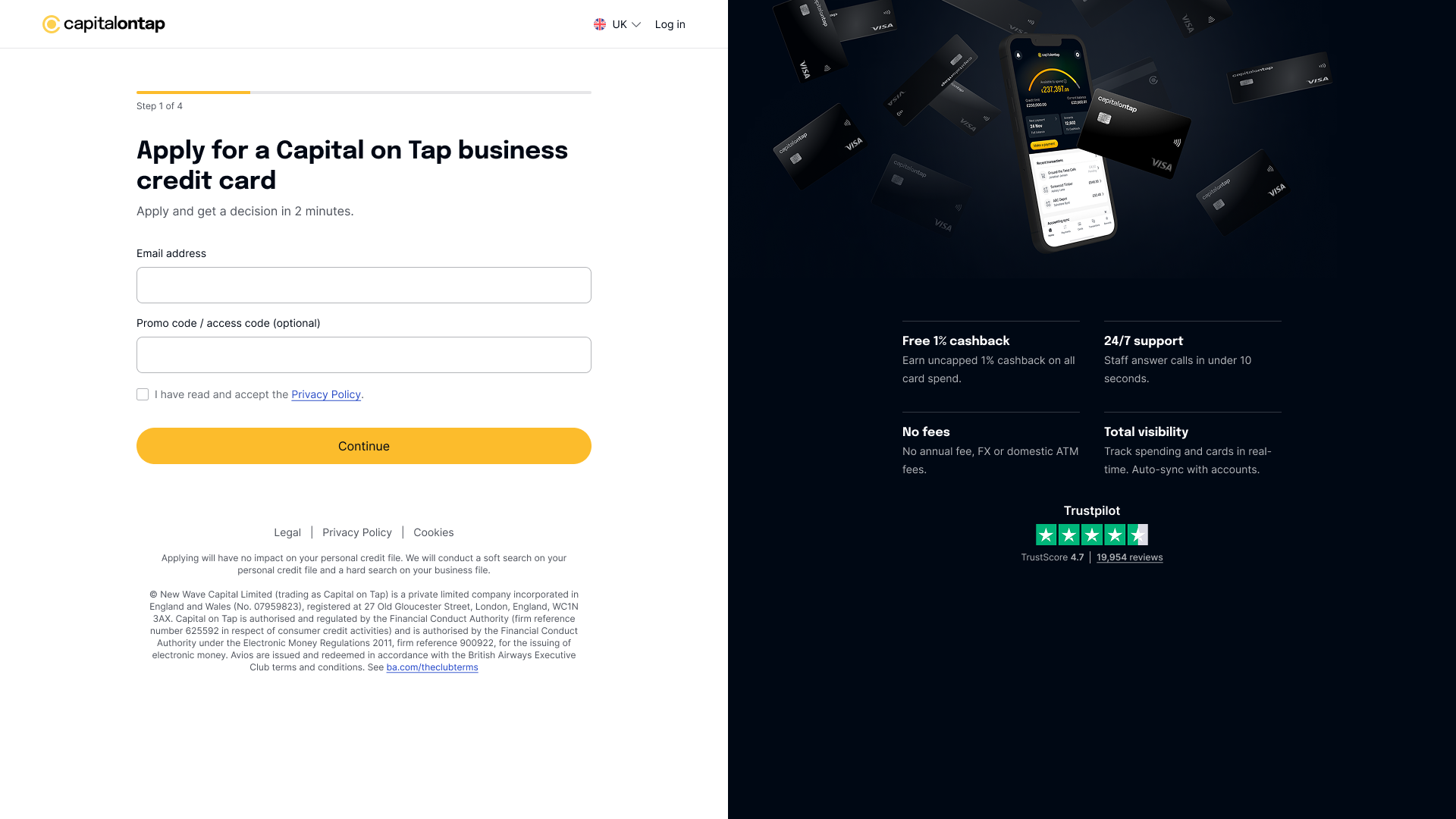
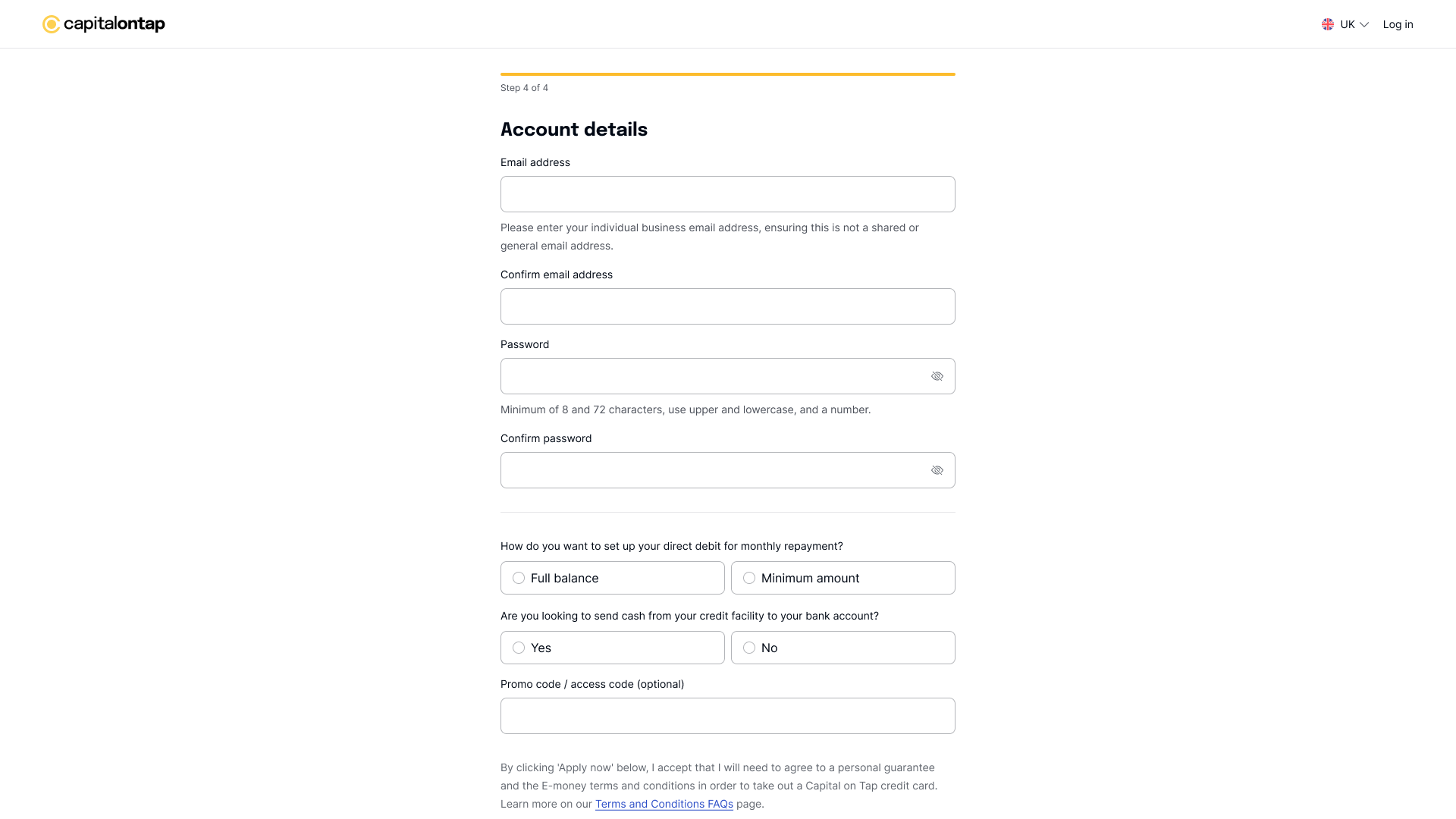
The credit check. Applying is a soft search and leaves no mark on your file. Accepting the offer triggers a hard one.
You can see your rate and limit before accepting the offer. The application uses a soft personal credit search; signing the agreement triggers a hard search on the business credit file, not your personal one.
The guarantee. Approval needs one from a director or major shareholder, so this isn’t a commitment you make on the company’s behalf alone.
What signing one exposes you to is set out under Regulation and Protection below. Read it before you accept a limit.
Fees, APR and Repayments
| Fees and rates | Detail |
|---|---|
| Rates from | 13.86% (floor rate) |
| Representative APR | Not printed on its product pages (checked October 2026) |
| Your offered rate | Set individually, usually well above the 13.86% floor |
| Interest-free period | Up to 42 days if cleared in full |
| Annual fee | £0 (free card) |
| Pro card fee | £299/year |
| Foreign transaction fee | None |
| ATM withdrawal fee | None (interest still applies) |
| Late payment fee | Can apply if a repayment fails; the amount is set in your credit agreement |
| Cashback | 1% uncapped on all spend (Free and Pro); Pro pays 1.25% on preloaded top-ups, 0.25 points more. |
| Example borrowing cost | Our tested offer: 4.94% monthly if uncleared, about £494 on £10,000 for one month. |
| Verified 5 October 2026. | |
The Example borrowing cost row uses one applicant’s real offer, not a typical rate.
Representative APR and Offered Rates
Capital on Tap is a lender rather than a bank, and it doesn’t publish a rate card. Every application is underwritten on its own: your filed accounts, how long you’ve traded, and the personal credit file of the director who signs.
That’s why the advertised 13.86% is worth so little as a planning number. It’s the best price on the book, and it goes to companies with the kind of trading history that would get them a decent rate almost anywhere.
A representative APR would be the more useful figure, because it’s the only one with a defined meaning: at least 51% of accepted applicants get that rate or better. Capital on Tap’s product, cashback and FAQ pages don’t print one. They print the floor, which tells you what the best customers pay and nothing about the rest of the book.
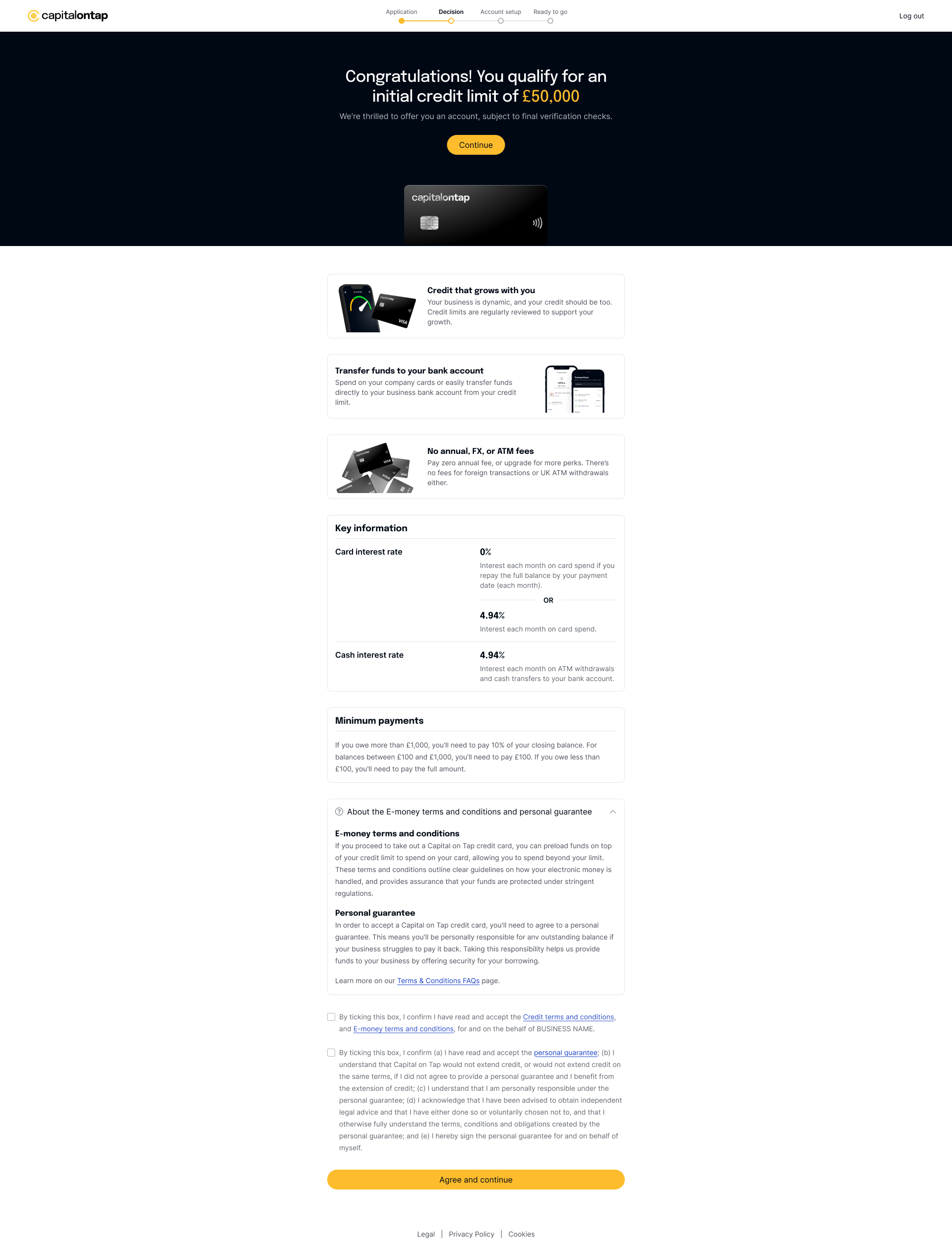
Your own number appears once, on the decision screen, after the soft search. It also arrives in a different unit. The offer we were shown quoted a monthly rate rather than an APR, and 4.94% a month reads a good deal smaller than the annual figure behind it.
The application costs you nothing and puts a real number in front of you. There’s no reason to accept anything on the strength of the advertised rate.
Interest-Free Period
Clear the statement in full and on time and you pay no interest at all. Capital on Tap gives you up to 42 days between a purchase and its payment date.
How much of that you actually get depends where in the billing cycle the purchase lands. A supplier invoice paid on day one gets close to the full six weeks. One paid the day before the statement closes gets a fortnight.
Used this way, the card can bridge the gap between paying for stock and receiving the sale proceeds. That is useful short-term working capital, provided the statement is cleared in full.
The interest-free period is not flexible. Paying most of the statement does not preserve part of the benefit; the balance has to be cleared in full.
Miss full clearance by any amount and interest runs at your offered rate from then on. The 42 days stop being free credit and start being the most expensive borrowing on your books.
When Interest Outweighs Rewards
Cashback only improves the deal while interest stays out of it. Once you carry a balance, compare the reward with the borrowing cost rather than treating them as separate benefits.
The reward side is fixed and easy to size. At 1% cashback, £5,000 a month of spend earns you £600 over a year.
The cost side is neither. At the 4.94% monthly rate our own offer screen quoted, a £10,000 balance costs about £494 for a single month.
Two months of that and the whole year’s cashback is gone, with £388 still to find. That was one application and we wouldn’t present it as typical, but it shows the shape of the problem.
A 1% return can’t outrun interest at that kind of level, and no rewards card anywhere solves that. What makes it sharper here is that you can’t price the risk in advance.
So if you expect to carry a balance for more than a few weeks a year, cashback isn’t the deciding factor and shouldn’t become one.
Get the offered rate, then set it against a card that quotes a representative rate up front. Barclaycard’s 25.5% is worse than this card’s floor and better than a bad offer, and you know which you’re getting before you sign.
Rewards, Cashback and Avios
Free Card Rewards
The free card earns 1% on everything, uncapped, with no annual fee to earn back first. That combination is rarer than it looks. Barclaycard’s Select Cashback card, the closest traditional equivalent, pays its 1% only on monthly spend above £2,000.
You can take the points as statement credit, as cash, or as gift cards. Or you convert them: 10 points to 8 Avios through the British Airways or Qatar Airways clubs, and 10 to 8 for Virgin Points.
For a company that clears its balance every month, this is the version to take. Most of the Pro pitch below is aimed at people who fly.
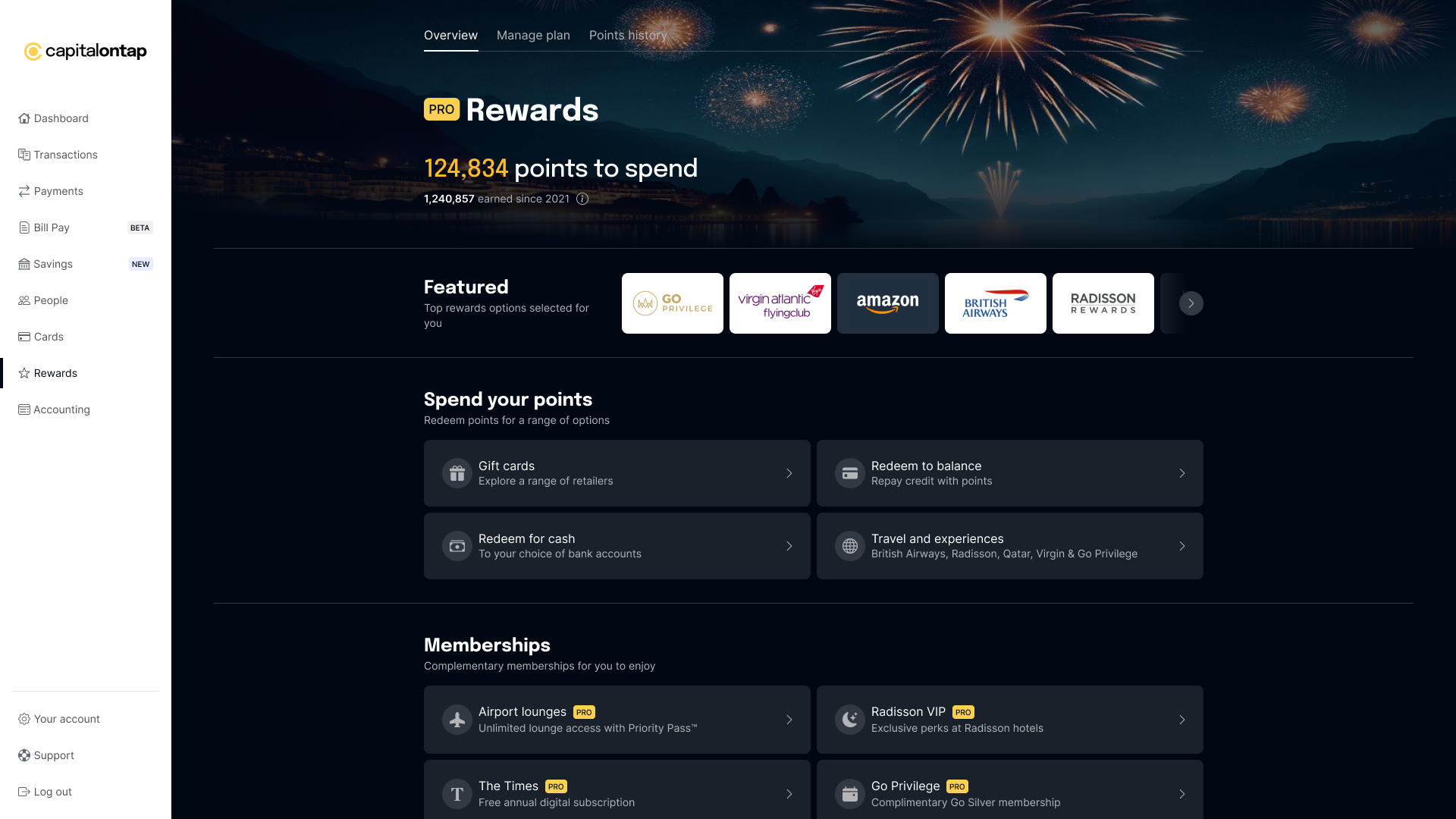
Pro Card Rewards
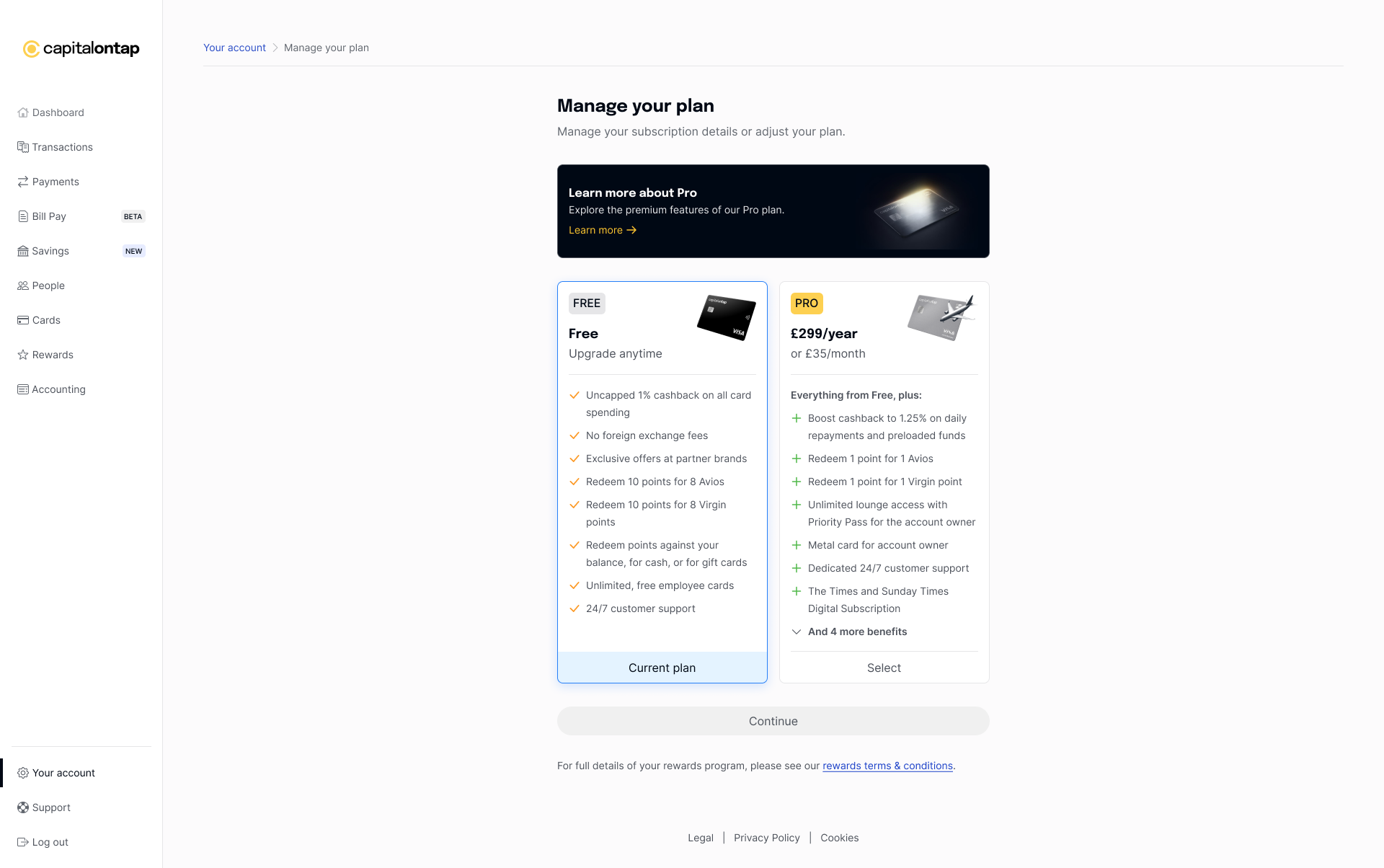
Pro costs £299 a year. Start with what it doesn’t change: ordinary card spend still earns 1%, exactly as on the free card. Nothing you buy day to day earns more because you paid the fee.
What Pro raises is the rate on preloaded spend, from 1% to 1.25%.
Preloading is worth explaining, because it isn’t a credit feature at all. You move your own money onto the card account, and Capital on Tap spends that before it touches your credit line.
It exists so you can make a purchase larger than your limit, and it earns cashback on the way through.
The rest of what Pro buys is travel: Avios at 1 point to 1 rather than the free card’s 10 points to 8, unlimited Priority Pass lounge access with two guest passes a year, Radisson VIP status and a Times subscription.
New members also get 10,000 points for spending £5,000 in the first three months. That’s a year-one benefit and should be counted once.
Whether any of that clears £299 comes down to how much you preload and how often you fly. The numbers answer it cleanly, and they’re below.
Free vs Pro
| Feature | Free Card | Pro Card |
|---|---|---|
| Annual fee | £0 | £299/year |
| Cashback | 1% uncapped | 1% uncapped; 1.25% instead of 1% on preloaded spend |
| Avios conversion | 10 points = 8 Avios | 1 point = 1 Avios |
| Virgin Points | Yes | Yes |
| Sign-up bonus | None | 10,000 points for £5,000 spend in 3 months |
| Best for | Everyday spend | Preloaded spend, frequent flyers and lounge users |
| Verified 5 October 2026. | ||
On ordinary spend there is nothing to decide. Both cards pay 1%, so a marketing director running £4,000 a month through ad platforms and software earns £480 a year either way. On the Pro card that same £480 has cost £299 to collect.
Preloading is where Capital on Tap makes its case for the fee, and the case has a hole in it.
Its own published break-even is £23,920 of preloaded spend a year, and the arithmetic is sound as far as it goes: £299 divided by 1.25%.
But it prices Pro against earning no cashback at all, and that isn’t the choice in front of you. The free card already pays 1% on exactly the same preloaded money.
The real gain from upgrading is the difference between the two rates, which is a quarter of a point. To earn £299 back from a quarter of a point you’d need to push £119,600 of your own cash through the card in a year.
So it isn’t a cashback decision. It’s a travel one.
Pro is worth £299 if the Avios conversion, the lounge access and the year-one bonus together come to more than the fee, and for a director who flies most months they may well. If you’re weighing it up for the cashback, take the free card.
We checked the fee and both cashback rates against Capital on Tap’s live pricing page in October 2026, and its £23,920 figure is quoted directly from its own Pro FAQ.
Features and Spending Controls
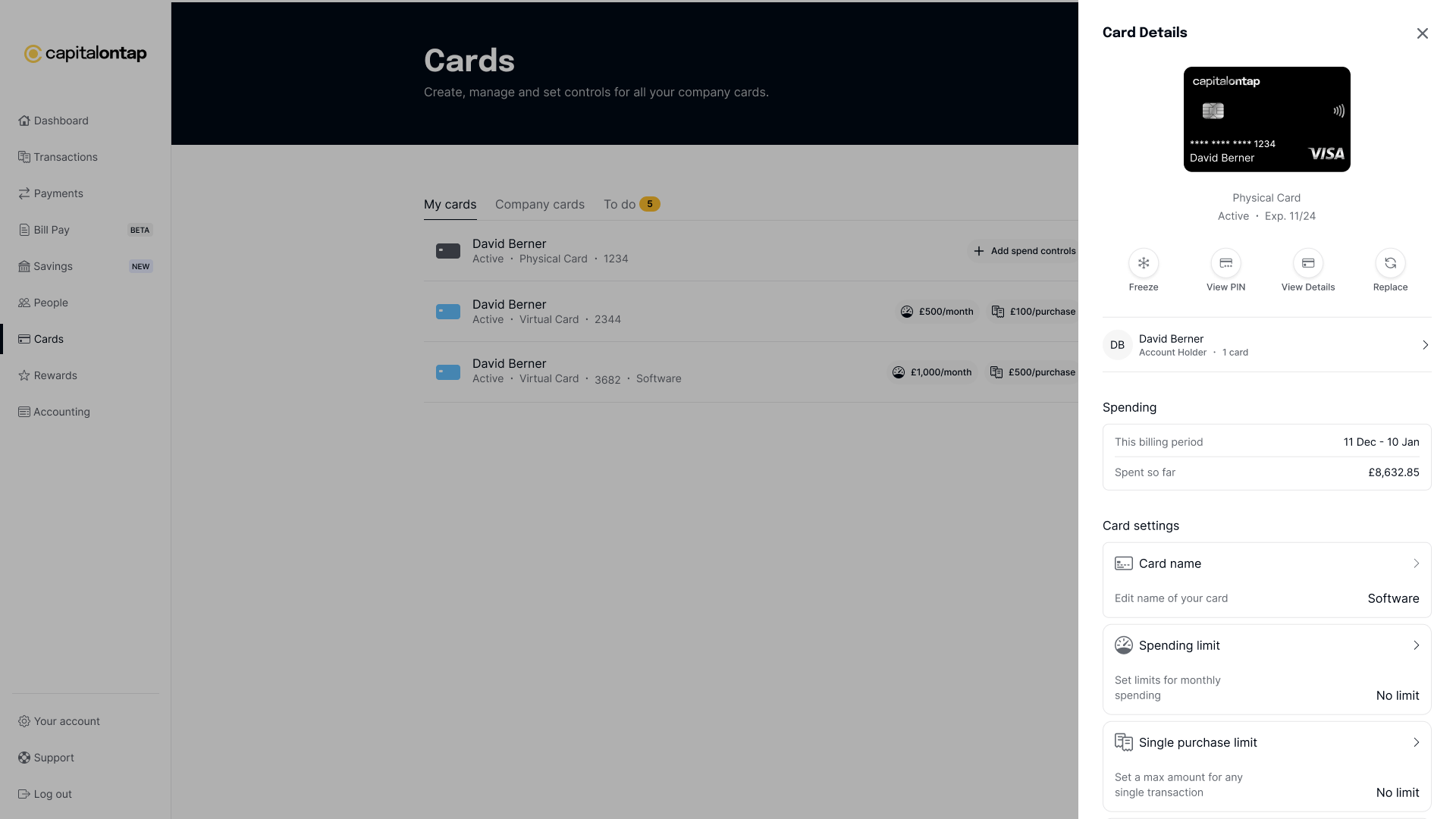
Employee cards. Unlimited and free, with a spending limit you set per card. That gives each employee their own controlled way to pay instead of making the team share a card or submit personal expenses.
Expense controls. Receipt capture and automatic categorisation reduce the manual sorting left for your finance team, although they do not add a manager’s approval before the money is spent.
The controls are preventative rather than procedural, and that distinction matters. You can stop a card spending above a set amount, but nothing waits for a manager to approve it. If you need sign-off before money moves, Moss is built for that and this isn’t.
Accounting. Direct connections to Sage, Xero, QuickBooks and FreeAgent, syncing daily and categorising by merchant, with 90 days of history pulled in when you first connect. Come to quarterly VAT and the return builds from reconciled data rather than a month-end scramble.
If you use none of those four, you’re exporting CSVs. That works, but it isn’t the same thing.
Overseas Spending
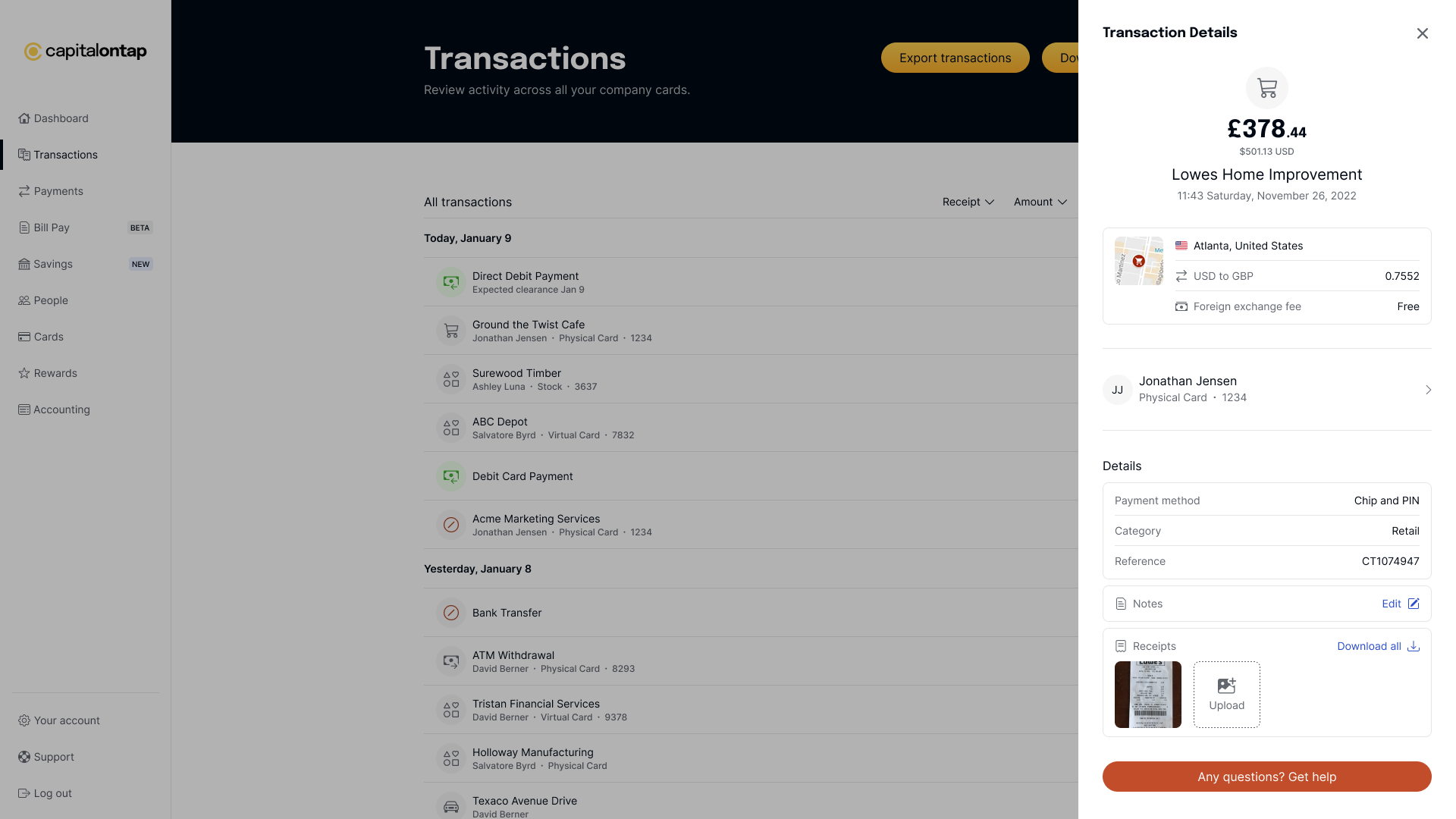
No foreign transaction fee and no ATM withdrawal fee. We verified both against the published fee schedule in October 2026, and our own US purchase bore it out: £378.44 at a Lowe’s in Atlanta, foreign exchange fee free.
Fee-free overseas spending still uses Visa’s exchange rate. Capital on Tap removes its own surcharge; it does not remove the conversion built into the network rate.
And cash withdrawals, fee-free as they are, start accruing interest the day you make them, with no interest-free period at all.
If you’re paying a US supplier every month, this is a better argument for the card than the cashback is. It also holds whether you clear the balance or not, which isn’t true of much else here.
Overseas card spend, paying overseas suppliers, and travel: the Visa network is widely accepted and there’s no FX surcharge on purchases.
Purchases convert at the Visa exchange rate. Cash withdrawals are fee-free but still accrue interest from day one, and business cards carry weaker dispute protection than personal cards.
Regulation, Protection and Personal Guarantee
| Protection | Where you stand |
|---|---|
| FCA status | Consumer credit: 625592 (register shows “applied to cancel”, October 2026); e-money: 900922 |
| Is it a bank? | No, a lender (New Wave Capital Limited) |
| FSCS protection | Not applicable (no deposits held) |
| Personal guarantee | Required from a director or major shareholder |
| Director liability | The guarantor can become personally liable if the company does not repay |
| Section 75 | Doesn’t apply to Capital on Tap business cards |
| Visa chargeback | May be available, subject to scheme rules |
| Missed payments | Interest at your offered rate and a possible late payment fee; can affect your credit file |
| Verified 5 October 2026. | |
Is it regulated? Yes. We checked the FCA register on 7 October 2026. Capital on Tap trades as New Wave Capital Limited (Companies House number 07959823), which is authorised for consumer credit under firm reference 625592, marked on the register as “applied to cancel”, and is an authorised e-money institution under 900922. It has lent to UK businesses for over a decade.
It isn’t a bank and holds no deposits, so FSCS protection doesn’t arise. When you’re borrowing rather than depositing, that makes no practical difference to you.
The personal guarantee. Every card requires one, signed by a director or a major shareholder, and it’s the most important thing on this page.
A personal guarantee sets aside the protection limited liability normally gives you. If the company can’t clear the card, Capital on Tap can pursue the person who signed for the balance personally.
Personal liability can therefore reach the guarantor’s savings and other assets, not just the company’s money. Court action is the last resort, but the exposure belongs to the person who signed.
This is standard for fintech lending to small companies, and Capital on Tap isn’t unusual in asking for it. But it should change how you size the facility.
A £250,000 limit is only attractive while you’re confident the company can service it, and the person carrying that confidence is the one signing.
Chargeback and Section 75. Section 75 doesn’t apply to a Capital on Tap business card, so the protection you may be used to on a personal card isn’t here.
If a supplier takes your deposit and never delivers, your route is a Visa chargeback. That’s a scheme process rather than a statutory right: it has time limits, it has conditions, and it can be refused.
That weaker protection matters most when you are paying a large deposit to a supplier you have not used before.
Customer Reviews
Capital on Tap scores 4.9 out of 5 on both app stores, as its own site showed in October 2026, and 4.6 (checked October 2026) on Trustpilot across 18,572 reviews.
The app-store ratings are higher than the Trustpilot rating, but the scores do not explain why. A smooth application that took two minutes and a disputed offered rate can produce very different reactions, so the platforms are best treated as separate signals.
Trustpilot does not show how representative its reviewers are of everyone who applied. The scores alone cannot support a claim about why somebody chose to leave a review.
What the negative reviews cluster around is the rate people were offered, which is precisely what individual underwriting produces.
An applicant offered a rate well above the advertised minimum has an immediate reason to leave a review. A customer whose card works without incident may never think to do so.
So public reviews can’t tell you how common that is across everyone who applied, and they shouldn’t be read as though they can.
The application uses a soft search of your personal credit file, so you can see the offered rate and reject it without affecting your personal credit score. An unattractive offer is a reason to walk away.
Alternatives to Capital on Tap
Sole traders and partnerships need an alternative that accepts their legal structure. Limited companies may instead want a card that publishes its rate before the application, so the two objections lead to different shortlists.
| Card | Best reason to pick it over Capital on Tap | Representative APR | Key trade-off | Apply |
|---|---|---|---|---|
| Barclaycard Select Cashback | Accepts sole traders and partnerships, and you know the rate before you apply | 25.5% (variable representative) | 1% cashback only on monthly spend above £2,000; lower limits than Capital on Tap | View Deal → |
| Moss | Built-in spend controls and per-employee cards for finance teams | No published rate (charge-style: repaid in full each cycle, 0% if on time) | Not a revolving credit line; built for established companies, not sole traders | View Deal → |
| Funding Circle Cashback | Higher intro cashback at a known representative rate | 34.9% (variable representative) | 2% cashback only for the first 6 months (capped £2,000), then 1%; needs 1 year trading and £30k turnover | View Deal → |
| Verified 5 October 2026. | ||||
We confirmed each of these rates against the provider’s own site in October 2026. Moss is the one to be careful with: it markets a charge-style product with no published representative APR, so it is not a substitute for a credit line, whatever the comparison tables suggest.
Final Verdict: Is Capital on Tap Worth It?
If my company cleared its card every month, I’d take this one. The limit is the highest you’ll find without a corporate relationship, the 1% is uncapped, there’s no annual fee to earn back, and I wouldn’t have to move my banking to get any of it.
On £12,000 a month of spend that’s £1,440 a year for changing nothing about how the business runs.
If I expected to carry a balance, I’d still apply, and then treat the decision screen as the actual product. The soft search costs nothing. The number it returns is the only one that matters, and until you’ve seen it you’re weighing a marketing figure against a real one.
What I wouldn’t do is take the £299 Pro card for the cashback. On everyday spend it earns exactly what the free card earns. Take it if you fly enough to use the lounges and the Avios rate, and not otherwise.
For a sole trader or a partnership the question doesn’t arise. Capital on Tap takes limited companies, LLPs and PLCs only, and no amount of turnover changes that.
Barclaycard’s Select Cashback card is the obvious first stop instead: a worse rate than this card’s floor, but one you can see before you apply.
Frequently Asked Questions
What APR will I actually get with Capital on Tap?
The starting rate is from 13.86% (variable), and Capital on Tap’s product pages print no other rate. Your individual rate depends on your company’s and director’s credit profile and is only confirmed after you apply. The application is a soft search, so checking your rate doesn’t affect your credit file.
Can sole traders get a Capital on Tap card?
No. Capital on Tap is restricted to UK limited companies, LLPs and PLCs registered at Companies House. Sole traders and partnerships can’t apply, so you would need a card that accepts sole traders directly, such as a high-street business account card.
Does Capital on Tap have an interest-free period?
Yes. You get up to 42 days interest-free on card purchases, but only if you pay your statement balance in full and on time each month. Carry a balance past the due date and interest applies at your offered rate, which is set individually and shown during the application.
Is Capital on Tap a real bank, and is it legit?
It’s legitimate, but it isn’t a bank. Capital on Tap is the trading name of New Wave Capital Limited, authorised by the FCA for consumer credit (firm reference 625592, which the register marked “applied to cancel” on 7 October 2026) and as an e-money institution (900922), and registered at Companies House (07959823); it has lent to UK businesses for over a decade and issues cards on the Visa network. As a fintech lender rather than a bank it carries no FSCS deposit protection, but since you’re borrowing rather than depositing, that distinction isn’t relevant here.
How much cashback does Capital on Tap pay?
Both tiers pay 1% cashback on all ordinary spend, uncapped. The Pro tier (£299/year) earns the same 1% on everyday purchases and 1.25% instead of 1% on preloaded top-up spend, so on ordinary spend the free and Pro cashback is identical. Capital on Tap quotes a £23,920 break-even for Pro, but because the free card already earns 1% on preloaded spend, the real gain from upgrading is only the extra 0.25 points, so Pro’s cashback only beats the free card above roughly £119,600 of preloaded spend a year.
Is Capital on Tap Pro worth it?
Pro costs £299/year. On everyday spend it earns the same 1% cashback as the free card, so it doesn’t pay for itself on ordinary purchases. What you get for the fee is 1.25% instead of 1% on preloaded top-up spend, a better 1:1 Avios conversion, lounge access and a Times subscription, plus 10,000 bonus points for £5,000 spent in the first three months. On cashback alone Pro rarely pays for itself; it pays off if you fly often enough to value the Avios and lounge perks. If you don’t, the free card wins.
Does Capital on Tap charge foreign transaction fees?
No. Capital on Tap doesn’t charge foreign transaction fees or ATM withdrawal fees, making it one of the cheaper options for overseas business spending. Cash withdrawals are fee-free but still accrue interest from the day you take them out.
How fast can I get a Capital on Tap card?
Capital on Tap says most applicants get a decision in under two minutes. On approval, you receive an instant virtual card you can use immediately while waiting for the physical card to arrive.
What credit limit can I get with Capital on Tap?
Limits run up to £250,000, which is significantly higher than most bank-issued business cards. Your actual limit depends on your company’s financials and credit profile.
Does Capital on Tap require a personal guarantee?
Yes. A company director or major shareholder has to sign a personal guarantee when you apply. It means that if the company can’t repay the card debt, the person who signed has to cover it personally, from their own money rather than the company’s. The credit limit sits with the company; the personal liability sits with the signatory.
Can you earn Avios with Capital on Tap?
Yes. Instead of taking your points as cashback, you can convert them to Avios through the British Airways Club or Qatar Airways Privilege Club. On the free card the rate is 10 points to 8 Avios; on the Pro card (£299/year) it improves to 1 point per Avios, and Pro adds 10,000 bonus points when you spend £5,000 in your first three months. Points also convert to Virgin Points or gift cards. For a director who flies regularly, Pro’s better conversion is where the annual fee can start to pay for itself.
How we reviewed Capital on Tap Credit Card
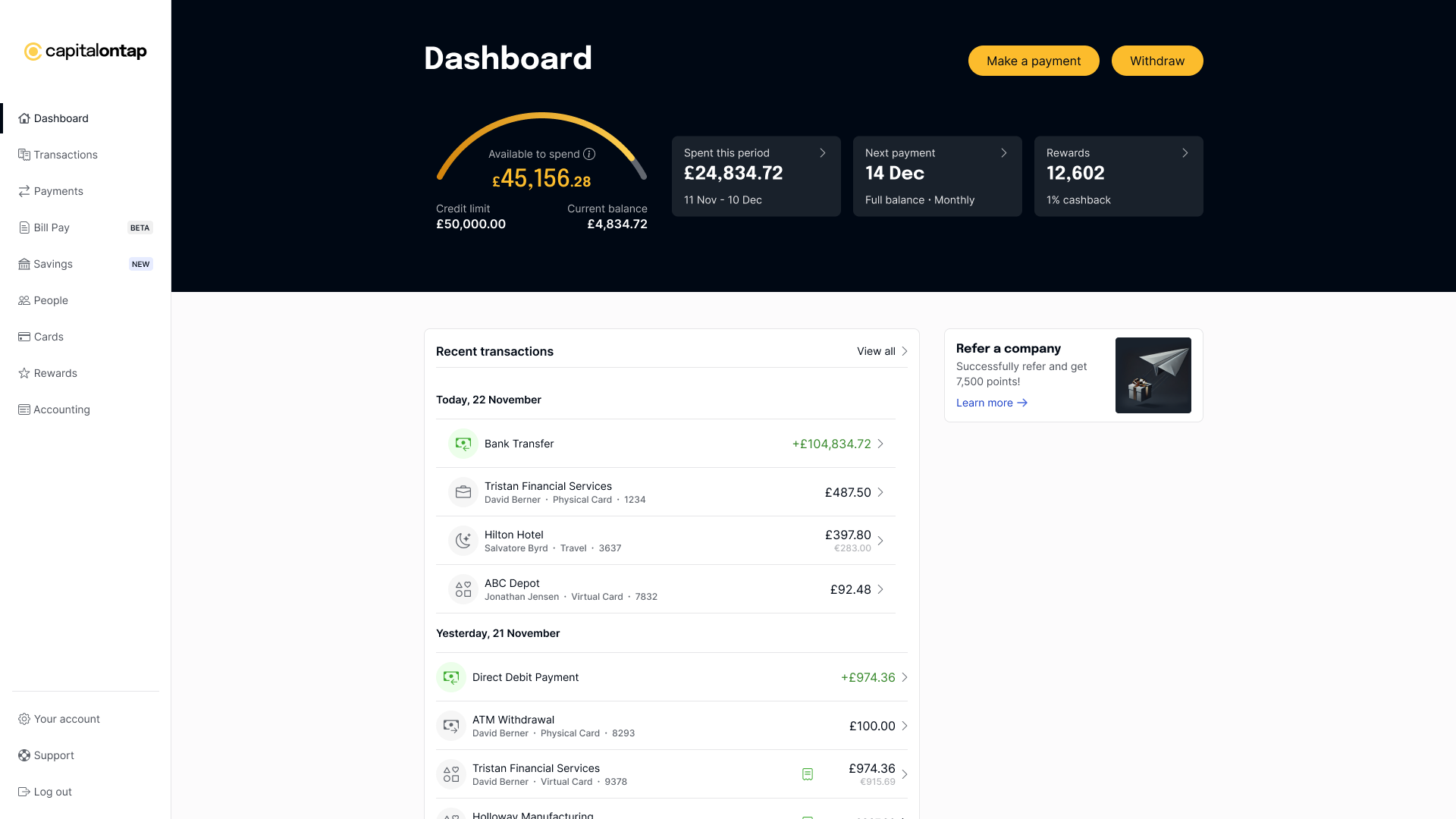
How we tested it. We applied for a Capital on Tap card, took the application through to the credit decision, and used the account: the dashboard, the card controls, the rewards portal and a live purchase from a US supplier. Every screenshot on this page comes from that account.
What we checked, and where. The 13.86% floor, the £299 Pro fee and both cashback rates come from Capital on Tap’s own pricing and product pages, re-checked in October 2026. Those pages print no representative APR, so we quote none. The fee schedule was reviewed in October 2026.
We cross-checked the regulatory position against the FCA register, and read the £23,920 Pro break-even directly off Capital on Tap’s own Pro FAQ so we could test how it was calculated.
Where we stopped short. Capital on Tap publishes no average offered rate, and we could not source one that held up, so this review prices the card as individually underwritten rather than quote a figure we cannot stand behind.
The 4.94% monthly rate on this page is what one application returned. We treat it as evidence of how wide the spread runs, not as a prediction of what you will be offered.
Review scores. The App Store and Google Play were checked in July 2026 and Trustpilot in October 2026, on a different cadence to the provider terms.
Update cadence. We re-verify this page regularly and when a provider changes pricing, eligibility or terms. Some links on this page are affiliate links; see our editorial policy.