







Cheapest Card Machines at a Glance
Square Reader is the cheapest card machine to buy in the UK at £19 plus VAT, and the cheapest to own while your card takings stay below about £199 a month. Above that, the lowest first-year cost of any reader we costed belongs to Lopay, at 0.79%, and it holds that position all the way up our range.
Lopay will not suit everyone, because that 0.79% buys you payouts once a week, on a Thursday. So what you get below is not one winner but a short list of them, each with the condition that comes attached to it.
If you cannot wait until Thursday, Lopay’s next-day tier costs 0.99% and still beats SumUp and Square above roughly £252 a month. If you would rather have a flat rate with no payout or account strings at all, SumUp Solo Lite takes over from Square at £833 a month, and Dojo’s 1.2% blended rate takes over from SumUp at £3,470.
Two things shift the answer as much as your turnover does. A fixed fee per transaction, which decides whether myPOS is the cheapest reader here or one of the dearest. And your card mix, because a headline rate quoted for domestic consumer cards can double the moment a company card comes across the counter.
This page costs the device: what you pay to buy it, and what you pay to keep running it. If it is processing rates, settlement and channels you are weighing up, that is cheapest card processing. If price is not your first question and you want the best machine rather than the cheapest, start with the best card machines.
We went through twelve providers’ own UK pricing pages on 3 and 4 August 2026 and costed every product they publish enough detail to cost. That gave us twelve products in the model, from eight providers. The other four price only after a sales call, so we rank them against nobody, and you will not find an invented rate for them here.
We built the sums into a model rather than typing them into the copy, so you can reproduce every figure below, and so a price change updates the whole page rather than one sentence somebody remembered to edit.
Likely winner under these assumptions
| What you need | Likely winner | Hardware | In-person rate | The condition attached |
|---|---|---|---|---|
| Cheapest physical reader to buy | Square Reader | £19 + VAT | 1.75% | Needs a phone. Non-UK cards cost 3.25%. |
| Lowest first-year cost above £199 a month, weekly payouts acceptable | Lopay Essential | £35 + £6.95 delivery (first-reader offer) | 0.79% | Weekly Thursday payouts. Amex, corporate and international cards add 1% each; categories stack. |
| Lowest first-year cost with next-day money | Lopay Standard | £35 + £6.95 delivery (first-reader offer) | 0.99% | Beats Square above £252 a month. Same card-type additions as Essential; each qualifying category adds 1% and they stack. |
| Cheapest flat rate with no payout or account conditions | SumUp Solo Lite | £25 + VAT | 1.69% | Needs a phone. Same rate on Amex and premium cards. |
| Cheapest flat rate above £3,470 a month | Dojo Go Max | £229 + VAT | 1.2% blended | Published rate applies below £100,000 a year. Contract terms conflict across Dojo’s own pages. |
| Cheapest standalone reader, larger baskets | myPOS Go 2 | £29 + VAT | 1.10% + 7p | Only beats SumUp above a £12.09 average sale. Funds land in a myPOS account. |
| Cheapest if you already pay for the account | Revolut Lite Terminal | £129 + VAT | 0.8% + 2p | Needs a Revolut Business plan from £10/month. There is no free tier. |
| Cheapest rented or contracted terminal | Quote required | Quote | Quote | Nobody can name this winner for you without your own written quote. |
For Lopay Essential, a corporate card from outside the UK adds 2% because the corporate and international categories stack.
Prices and fees checked 3 and 4 August 2026. Hardware prices exclude VAT unless stated. First-year figures assume a £20 average sale on domestic consumer cards. Promotions can change without notice.
Full Card Machine Cost Comparison
The column that catches people out is not the headline rate. It is the one sitting next to it. A provider quoting 1.10% looks cheaper than one quoting 1.69% until you spot the 7p riding on every sale, and a provider quoting 1.75% turns into 3.25% the moment your customer hands over a card issued abroad.
| Provider | Device | Type | Hardware (ex VAT) | Monthly | Domestic consumer | Fixed fee | EEA / international | Amex | Account needed | Settlement | Contract |
|---|---|---|---|---|---|---|---|---|---|---|---|
| Square | Square Reader | Phone-paired | £19 | £0 | 1.75% | None | 3.25% | 1.75% | Free Square account | Next business day | None |
| SumUp | Solo Lite | Phone-paired | £25 | £0 | 1.69% | None | 1.69% | 1.69% | Free SumUp account | 1 to 3 business days | None |
| SumUp | Solo | Standalone | £79 | £0 | 1.69% | None | 1.69% | 1.69% | Free SumUp account | 1 to 3 business days | None |
| SumUp | Payments Plus plan | Plan | Reader cost | £19 or £189/yr | 0.99% | None | 1.69% | 1.69% | Free SumUp account | 1 to 3 business days | None |
| myPOS | Go 2 | Standalone | £29 | £0 | 1.10% | 7p | 2.20% / 2.85% | 2.45% | Free myPOS account | Instant to myPOS account | None |
| Revolut | Lite Terminal | Standalone | £129 | From £10 | 0.8% | 2p | 2.6% | 1.7% | Revolut Business plan | Within 24 hours | None |
| Lopay | Card Reader (WisePad 3), Essential | Phone-paired | £35 + £6.95 (first-reader offer) | £0 | 0.79% | None | 1.79% | 1.79% | Free Lopay account | Weekly, Thursdays | None |
| Lopay | Card Reader (WisePad 3), Standard | Phone-paired | £35 + £6.95 (first-reader offer) | £0 | 0.99% | None | 1.99% | 1.99% | Free Lopay account | Next day, Monday to Friday | None |
| PayPal | PayPal Reader | Phone-paired | £29 (first reader) | £0 | 1.75% | None | 1.75% | 1.75% | Free PayPal account | Minutes, to the PayPal balance | None |
| Dojo | Go Max | Standalone | £229 | £0 on Essential | 1.2% blended | None | 1.2% blended | 1.2% blended | Dojo merchant account | Next day | Public information conflicts, get it in writing |
| Tide | Card Reader, Essential | Phone-paired | £39 | £17.99 | 0.89% debit only | 3p | Not published | Not published | Tide business account | 2-3 working days; next day on Premium | None |
| Tide | Card Reader, pay as you go | Phone-paired | £49 | £0 | 1.5% debit only | 5p | Not published | Not published | Tide business account | 2-3 working days | None |
That table prices the inputs. What you actually want is the output, so here is the same shortlist as a first-year total: what each one costs you over twelve months, with the hardware paid in full, a £20 average sale and domestic consumer cards throughout.
| Device or plan | £1,000 a month | £3,000 a month | £5,000 a month |
|---|---|---|---|
| Lopay Card Reader, Essential 0.79% | £137 | £326 | £516 |
| Lopay Card Reader, Standard 0.99% | £161 | £398 | £636 |
| myPOS Go 2 | £203 | £551 | £899 |
| SumUp Solo Lite | £228 | £633 | £1,039 |
| Square Reader | £229 | £649 | £1,069 |
| PayPal Reader | £239 | £659 | £1,079 |
| Revolut Lite Terminal, including the £10 plan | £357 | £573 | £789 |
| SumUp Solo | £282 | £687 | £1,093 |
| Tide Card Reader, pay as you go | £259 | £679 | £1,099 |
| SumUp Payments Plus, on a Solo Lite | £372 | £609 | £847 |
| Dojo Go Max | £373 | £661 | £949 |
| Tide Card Reader, Essential | £380 | £629 | £879 |
| Tide Card Reader, Premium (monthly, 12-month contract) | £370 | £571 | £773 |
Tide sells the same reader at three different prices. Pay as you go costs £49 plus VAT for the device and 1.5% plus 5p. Essential drops that to 0.89% plus 3p and £39 plus VAT for the device at £17.99 a month, while Premium charges 0.69% plus 3p and £29 plus VAT at £19.99 a month on a 12-month contract.
Read Tide’s footnote before that 0.89% tempts you, because it covers domestic consumer debit cards only. Tide does not publish what it charges on credit, commercial or international cards, pointing you at its product terms instead.
Our Tide totals above therefore cover debit cards only; credit, commercial and international card costs are excluded because Tide does not publish separate rates for them. Even on debit, the plan fee has to be earned back before the lower rate is worth anything to you, and Tide lands mid-table at every turnover we modelled.
Take it if you want the Tide account anyway. Do not take it as a way to pay less for accepting cards.
Dojo’s £229 is its standard price. It is running a launch offer at £149 until 31 August 2026, which we have kept out of the rankings below, because a temporary discount should not masquerade as a permanent one.
Cheapest Card Machines by Monthly Turnover
Hardware is a one-off and processing is forever, so the machine that is cheapest for you at £500 a month is rarely the cheapest at £5,000. The two boundaries below fall out of the arithmetic rather than being picked for tidiness.
All three bands assume a £20 average sale on domestic consumer cards, one reader, and the hardware paid for in full in year one. Each band gives you the outright cheapest option first, then the cheapest one carrying no payout or account condition, because for a lot of businesses those are two different answers.
Cheapest Below £199 a Month
Down here the device price is most of what you pay, so buy the cheapest device: Square Reader, at £19. You are not processing enough for a rate difference to overturn a hardware gap.
Across the first year at £100 a month we make Square £40. Lopay would cost you £42 for the reader and its delivery before it processed a single payment, which is why the lowest rate on the page still loses down here.
Your crossover with Lopay lands at £199 a month, and with SumUp Solo Lite at £833. Solo Lite costs £6 more than Square Reader and charges 1.69% against Square’s 1.75%, a saving of 0.06 percentage points. Recovering £6 at 0.06p in the pound takes £10,000 of annual card turnover, which is £833 a month.
One caveat matters more than any of those gaps. If a meaningful share of your customers are visitors, steer clear of Square even here: it adds 1.5% on cards issued outside the UK, taking those sales to 3.25%. SumUp charges 1.69% wherever the card came from.
Cheapest From £199 to £3,470 a Month
Lopay Essential is the cheapest option through this entire band, and the price of it is being paid on Thursdays. At £1,000 a month we make it £137 in year one against £228 for SumUp Solo Lite and £229 for Square. At £2,000 it is £232 against £431 and £449.
Those are not marginal gaps, and we are not going to bury them because Lopay is a small name. If your cash flow can absorb a weekly cycle, this is the cheapest way for you to take cards in this band. If it cannot, the next-day tier at 0.99% still beats both mainstream readers from £252 a month.
If you would rather have a rate with no payout condition and no account attached, SumUp Solo Lite is your answer through this band. Its real advantage is the one comparison tables usually bury: 1.69% is what you pay on everything. Amex, premium cards, business cards, cards issued abroad.
Most providers in this category advertise a low domestic rate and quietly recover the difference on the cards you have no control over. SumUp does not, and if you cannot predict your card mix that is worth more to you than a headline rate.
Revolut is the one I would model twice, because the answer turns entirely on who is paying for the account.
If you would be opening Revolut Business purely to get the device, that £10 a month is a genuine cost of your decision, and its 0.8% plus 2p does not overtake Solo Lite until £2,363 a month in year one, or £1,266 on running costs alone once the hardware is behind you.
If you already pay for Revolut Business, the plan is not attributable to the device at all, and on that basis it overtakes Solo Lite at £1,097 a month. I would not open the account just to get the rate. If the account is already yours, it is worth the sums.
Those first-year numbers moved a long way in August, and not because Revolut changed a price. It stopped selling the £49 Reader, so the cheapest way in is now the £129 Lite Terminal, and £80 of extra hardware takes a lot of 0.8% transactions to earn back.
Heading for the top of this band, look at SumUp Payments Plus before you switch provider entirely. It drops your rate to 0.99% for £19 a month, or £189 a year. On monthly billing it pays for itself at £2,714 of card turnover; on the annual plan, which works out at £15.75 a month, at £2,250.
Read the small print on that 0.99% though, because it covers domestic debit and credit cards only. Your premium, international and Amex sales stay at 1.69%.
Cheapest Above £3,470 a Month
Lopay Essential still wins outright, and £3,470 is where the best condition-free flat rate changes hands from SumUp to Dojo. At £5,000 a month we make Lopay £516 in year one, Revolut £709 with its plan counted, Dojo £949 and Solo Lite £1,039.
Dojo never actually takes the outright title on domestic consumer cards at a £20 average sale. The version of this page that said it did was comparing Dojo against two rivals while ignoring four others sitting in its own table.
What Dojo does win is the flat-rate contest. Its 1.2% is a blended rate, so a single number covers every card type you take, including commercial, international and Amex. Against SumUp’s 1.69% that is worth £90 a year to you at £5,000 a month, even after paying £229 for the device.
That matters most where your card mix is unpredictable, which is the section below. Against Lopay it is closer than the headline rates suggest, because Lopay charges 1.79% on Amex, corporate and international cards while Dojo charges 1.2% on everything.
On a mix that is a fifth commercial, Lopay Essential works out at about 0.99% blended, so it stays ahead. But the gap narrows with every company card you take.
The published 1.2% holds below £100,000 of annual card turnover, roughly £8,333 a month. Above that Dojo moves you onto a custom rate and you are into quote territory, where no comparison page can help you.
At this volume Lopay’s weekly payout stops being a minor inconvenience and becomes a real cash flow decision. Taking £8,000 a month means carrying around £1,800 of your own money at any moment. Price that against the rate before you chase it.
How Average Transaction Value Changes the Cheapest Machine
A fixed fee per transaction is invisible in a rate comparison and brutal on small baskets. Seven pence sounds like nothing. On a £5 coffee it is 1.4%, which is more than some providers charge in percentage terms for the whole sale.
| Fixed fee | £5 sale | £10 sale | £20 sale | £50 sale | £150 sale |
|---|---|---|---|---|---|
| 2p (Revolut) | 0.40% | 0.20% | 0.10% | 0.04% | 0.01% |
| 3p (Tide Essential and Premium) | 0.60% | 0.30% | 0.15% | 0.06% | 0.02% |
| 5p (Tide pay as you go) | 1.00% | 0.50% | 0.25% | 0.10% | 0.03% |
| 7p (myPOS) | 1.40% | 0.70% | 0.35% | 0.14% | 0.05% |
To work this out properly you cannot go from turnover alone. Count your transactions first: monthly turnover divided by average sale gives the number of payments, and the fixed fee lands on every one of them. Your monthly cost is turnover times the percentage, plus transaction count times the fixed fee.
The two boundaries below are myPOS crossovers specifically, not universal ones, and we have quoted them at £3,000 a month on a first-year basis. They move with your turnover, because the hardware cost is spread over more sales: at £1,000 a month myPOS does not overtake Square until £12.35, and at £5,000 it does so at £11.05.
A provider with a different fee and a different percentage crosses somewhere else entirely, which is the whole point.
Transactions Below £11.25
Below this basket size myPOS costs you more than Square, whatever the 1.10% headline suggests. At a £6 average sale, myPOS works out at an effective 2.27% once the 7p is folded in, against Square’s 1.75% and SumUp’s 1.69%.
The gap is not academic. A cafe taking £3,000 a month at £6 a time runs 500 transactions, and we make myPOS £845 across the first year against Solo Lite’s £633. Run the same business at a £20 average sale and myPOS costs £551, comfortably ahead of SumUp. Same provider, same published rates, opposite conclusion, decided entirely by basket size.
What is not true, and what we used to tell you here, is that every provider charging pence per transaction costs more than Square below this point. Revolut charges 2p, not 7p, and at £3,000 a month it overtakes Square at an average sale of £3.75 and SumUp at £4.08. A small fixed fee attached to a much lower percentage behaves nothing like a large one.
Transactions From £11.25 to £12.09
This narrow band is the only place your answer depends on which flat-rate provider myPOS is measured against. myPOS overtakes Square at £11.25, because Square’s 1.75% leaves a 0.65 percentage point gap for the 7p to be recovered from. It does not overtake SumUp until £12.09, because SumUp’s 1.69% leaves only 0.59 points to work with.
Both figures assume £3,000 a month in year one. Push your turnover up and both fall, because the hardware is being carried by more sales.
A band this narrow is not worth agonising over. If your average sale lands in here, choose on settlement speed, on whether you need the device to work without a phone, and on whether you want your money in a bank account or a myPOS one. Those differences are worth real money to you. This one is worth pennies.
Transactions Above £12.09
The fixed fee stops mattering and the percentage takes over. At a £150 average sale, 7p is 0.05% of the transaction, which is a rounding error. myPOS at 1.10% is now comfortably cheaper than SumUp at 1.69% or Square at 1.75%.
Higher-value sales bring a different problem though, and it is the one that actually costs tradespeople money: card mix. myPOS charges 2.85% on commercial and international cards and 2.45% on Amex, against a domestic consumer rate of 1.10%.
If you invoice businesses, a good share of what you take will arrive on company cards at more than double the headline rate. Work out your real split before you choose, because the point at which that reverses the answer is lower than most people expect. We have costed it in the tradespeople section below.
Cheapest Card Machines by Business Type
The three profiles below use the same method and show their inputs, so you can drop your own figures in.
Coffee Shops and Bakeries
Low basket, high volume, and the fixed fee is the whole game. On a £6 average sale at £3,000 a month, that is 500 transactions, and anything charging pence per payment is quietly taxing every single one.
Costed across the first year, we make SumUp Solo Lite £633 and Square Reader £649. myPOS Go 2, which looks like the cheapest option in any table sorted by percentage, comes to £845.
That is more than £200 a year worse than the reader that looks dearer on paper, and the difference is entirely the 7p. On baskets this small the fixed fee swallows the saving whole.
Revolut deserves a mention at £657, because 0.8% plus 2p survives contact with small baskets better than any other rate here. What sinks it on this profile is not the rate but the entry price: £129 for the Lite Terminal since the £49 Reader was withdrawn, plus £10 a month that is baked in whether you take £500 or £5,000.
Lopay is cheaper again at £326, and that is the honest answer on cost. If you live on daily cash flow, think hard before agreeing to be paid on Thursdays. But a £300 a year difference buys quite a lot of thinking.
Market Traders and Mobile Businesses
Connectivity is worth more to you than a few basis points here, because a reader that cannot find a signal is not a cheap reader, it is a lost sale. On a £20 average sale at £3,000 a month, the spread between the mainstream options is narrower than the damage one dead pitch does.
Square Reader and SumUp Solo Lite both need a paired phone, which is fine until your battery dies or the signal goes.
If you asked me to pick one reader for a stall, it would be the myPOS Go 2 at £29. It ships with a free data SIM and 2.4GHz WiFi, and at this basket size we make it £551 across the first year, less than either phone-paired option. SumUp Solo does the same job on the same flat 1.69% for £79.
Be clear about where your money lands, though. myPOS pays instantly, but it pays into a myPOS account, not your bank, and moving it on costs £1.50 a transfer in sterling.
Leave it there and that costs you nothing. Sweep it weekly and it is £78 a year, taking our £551 to £629. Sweep it every trading day and it is £390, taking the total to £941 and turning the cheapest standalone reader into the dearest option on this profile.
So “instant settlement” is doing rather less work in that sentence than it first appears.
Tradespeople and High-Ticket Businesses
Fixed fees are irrelevant and card mix decides everything. At a £150 average sale on £5,000 a month you are running 33 transactions, and 7p across all of them is about £2.30 a month. Nobody should pick a provider on that.
On pure domestic consumer cards myPOS wins this profile at £717 in year one, against £949 for Dojo and £1,039 for SumUp Solo Lite. We previously published £899 for myPOS here and had Dojo beating it. That £899 was the figure for a £20 average sale, carried across when the inputs changed to £150 and never recomputed, which is exactly the error the cost model exists to catch.
What decides it in practice is what your customers pay with. A domestic consumer card on myPOS costs 1.10%; the same sale on a company card costs 2.85%. Dojo’s 1.2% refuses to make that distinction, so the two cross at a particular card mix rather than a particular turnover.
On this profile your crossing point is a commercial and international share of 22%. Below it myPOS is cheaper: if a tenth of your takings arrive on company cards it costs you £822 against Dojo’s £949. Above it Dojo pulls ahead: at a third, myPOS costs you £1,032 and Dojo is unchanged at £949, because a blended rate does not care what you hand it.
If you invoice other businesses, 22% is a threshold you may well be over without ever having counted. It is the number I would whittle down first, before comparing a single headline rate.
One further cost only bites at this end. If you take deposits over the phone, those are keyed transactions at a different and higher rate, and a provider that looks cheap in person can be expensive the moment your customer is not standing in front of you.
No-Contract Readers Versus Rented Card Machines
Renting used to be the only way to get a proper terminal. It is now mostly the expensive way. The pitch is that you spread the hardware cost and get support and replacement bundled in. What goes unmentioned is that you also give up the ability to walk away.
| Buy outright | Rent or pay monthly | |
|---|---|---|
| Upfront cost | £19 to £229 | Usually nothing |
| Monthly commitment | None | £15 to £25 per device |
| Processing basis | Published rate | Often quoted, not published |
| Contract | None | 12 months is typical |
| Hardware replacement | Your problem | Usually included |
| Leaving | Stop using it | Notice period, possible exit fee |
| Suits | Most small businesses | Multi-site, high volume, or needing bundled support |
Dojo offers you both routes on the same device: £229 upfront or £25 a month. Twelve months of that is £300, so buying wins inside a year unless you genuinely value the replacement cover.
Lopay’s Business Terminal is £15 a month on a 12-month contract, which is the one place Lopay does tie you in. takepayments is quote-only on a 12-month contract, shorter than the 12 to 36 months we previously claimed here.
A quote-led terminal may well work out cheaper at higher volume, and if you turn over £20,000 a month you should get quotes. But there is no safe universal crossover without your own average sale, card mix, hardware charge, authorisation fee and a written quote in front of you.
The version of this page that put £12,000 on it was quoting a number nobody could support.
Cheapest Card Machine Providers Compared
Square
The cheapest way to start taking cards, and still where I would point a brand new business first. £19 plus VAT for the Reader, 1.75% flat, no monthly fee, no contract, on an account that opens in minutes.
Where it stops being cheap is on non-UK cards. Those carry an extra 1.5% and land at 3.25%. I think that surcharge is the most under-reported cost in this category, and if you trade anywhere tourists go it should settle your answer on its own.
Square also keeps the processing fee when you refund a sale, which its own payment terms state plainly. There is no standard chargeback fee, and Square covers the cost of disputes it fights on your behalf.
Cheapest for occasional and low-volume sellers on domestic cards, up to about £199 a month. The wrong choice if you serve tourists. We checked this on 3 August 2026 against Square fees.
Get Square Reader →SumUp
The safest flat rate here, because 1.69% genuinely means 1.69%: the same on Amex, premium and international cards as on a domestic debit card. Solo Lite is £25 plus VAT and pairs to a phone. Solo is £79 and works on its own.
The SumUp Air we used to lead this page with is discontinued, and it has no business appearing on any 2026 comparison. Payments Plus drops your rate to 0.99% for £19 a month or £189 a year, worth taking above £2,714 or £2,250 a month respectively. That 0.99% covers domestic debit and credit only.
Cheapest if you cannot predict your card mix and want no account or payout conditions. Beaten on pure rate by several rivals. We checked this on 3 August 2026 against SumUp pricing.
Get SumUp Reader →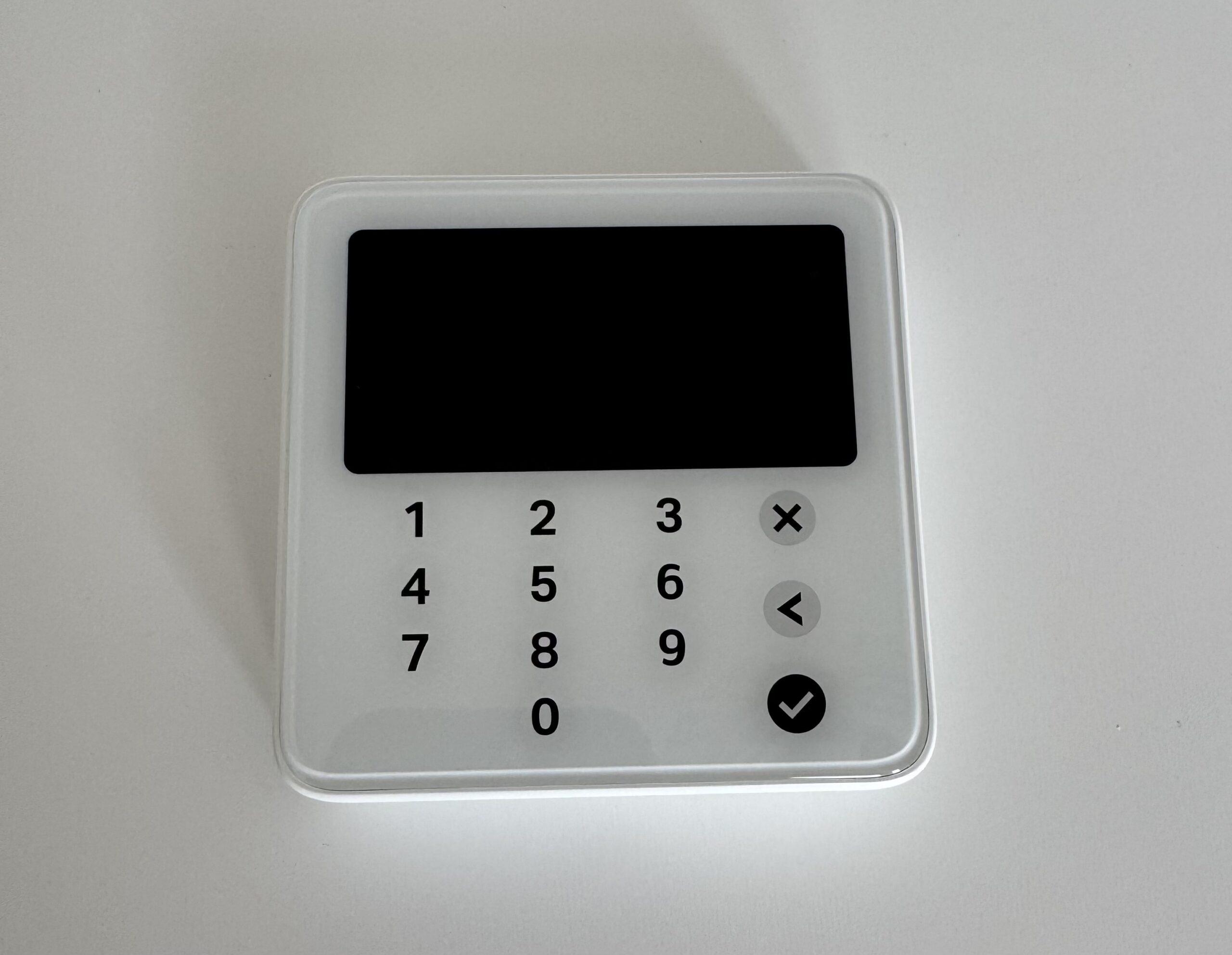
myPOS
A standalone reader for £29 plus VAT with a free data SIM, which is remarkable value for the hardware alone. There is no monthly or annual account fee at all.
It has tactile physical buttons rather than a touchscreen, and no built-in printer, whatever older reviews tell you. Printing means buying the Go Combo, the reader and a printing dock together at £169 excluding VAT. That is the figure on myPOS’s own product page, and it rather undoes the £29 headline if you need paper receipts.
The rate is 1.10% plus 7p on domestic consumer cards, rising to 2.20% on EEA consumer, 2.45% on Amex and 2.85% on everything else. Those published rates apply below £10,000 a month.
Your funds arrive instantly, but into a myPOS account rather than your bank, and a sterling transfer out costs £1.50. Budget for that if you sweep often, because it is the one cost here that can quietly reverse the ranking.
Cheapest standalone option above a £12.09 average sale on domestic cards. Expensive on small baskets and on business cards. We checked this on 4 August 2026 against myPOS fees.
Get myPOS Go 2 →Revolut
The lowest mainstream rate at 0.8% plus 2p, and it now costs a great deal more to get at. Revolut has discontinued the £49 Revolut Reader, so the cheapest way into that rate is the Lite Terminal at £129 plus VAT. Sitting on top of that is a Business plan from £10 a month, because the free tier went too.
Unsurprisingly, that combination pushes Revolut a long way down this page for anyone starting out. The rate is still the best of the mainstream names; the toll on the door is now £129 and a subscription.
If you already own a Reader you can keep using it, and it carries a one-year warranty; if it fails inside that year Revolut offers a discounted Terminal or a refund matching what you paid. Nobody who did not already buy one can pair a new one.
Whether the rate is worth the entry price depends entirely on whether the account is already yours. Counting the plan as a cost of the device, Revolut overtakes SumUp Solo Lite at £2,363 a month in year one and £1,266 on running costs after it. Not counting it, because you pay for Revolut Business regardless, it overtakes at £1,097.
Be careful reading Revolut’s own pages on this. Its card machines page was still advertising the £49 Reader when we checked on 4 August 2026, while two help centre pages said plainly that it is no longer sold. We have gone with the help centre.
Refunds cost you nothing extra, chargebacks are £15 and refunded if you win, and money reaches your Revolut account within 24 hours.
Worth it if you already pay for Revolut Business and take more than about £1,100 a month. Poor value if you would be buying a £129 device and a £10 plan purely to reach a low rate. We checked this on 4 August 2026 against Revolut payment acceptance pricing and the Revolut Business help centre.
Get Revolut Lite Terminal →Lopay
The lowest published in-person rate we found anywhere in this comparison, at 0.79%, on a £35 reader (the in-app, first-reader price; subsequent readers are priced higher) with no contract and no monthly fee. On our costing it is the cheapest way to take cards from about £199 a month upwards, and we would rather say so than pretend the arithmetic went another way.
That rate buys you payouts once a week, on a Thursday. Next-day money costs 0.99% and instant costs 1.79%, so Lopay is really three products wearing one price list, and the tier you actually need may not be the one in the headline.
Amex, corporate and international cards each add 1% on every tier, and the categories combine: a corporate card from outside the UK adds 2%, not 1%. Payments are processed by Stripe.
Cheapest on rate and on first-year total if your cash flow can absorb a weekly cycle, and still ahead of the mainstream readers on the next-day tier above £252 a month. We checked this on 3 August 2026 against Lopay pricing.
PayPal
The current product is the PayPal Reader at £29 plus VAT for your first one and £69 after that. Zettle Reader 2 and PayPal Here are both retired names, and any page still quoting them at you is out of date.
The rate is 1.75% across major cards and mobile wallets including Amex, level with Square and a shade above SumUp. No monthly fee, no contract.
Your money moves faster than we previously said. PayPal states funds typically arrive in your PayPal Business account within minutes; the one to two business days we used to print in the settlement column is how long the hardware takes to reach you. Getting it from the PayPal balance to a bank account is a separate step.
Cheapest if you already run PayPal and want a single reconciliation. Nothing here beats SumUp or Square on price alone. We checked this on 4 August 2026 against PayPal POS pricing.
Dojo
The provider whose position has shifted most, and the main reason we rebuilt this page. Dojo now publishes 1.2% as an all-in blended rate covering every card type, on a free Essential plan, with the Go Max at £229 or £25 a month.
That blended rate is the product, not the turnover threshold. Against SumUp, which is also flat, your card mix is irrelevant and only volume decides it, so Dojo takes over at £3,470 a month. Against Lopay, which adds 1% for corporate cards and 1% for international cards (the additions combine if a card qualifies under more than one category), mix is what matters: Dojo needs a commercial share above roughly a third before it closes the gap.
The contract position is where Dojo’s own public information does not hold together. Its FAQ page states that for businesses under £1m card turnover a year, contracts are 12 months and then become monthly rolling.
Its pricing page describes a 12-month fixed or 30-day rolling choice only for businesses above £100,000, and states no term at all for the tier below that. Its card machine page advertises a “commitment free” offer, which its own footnote defines as no early account closure fee in the first 30 days.
Three different pictures of the same commitment, and you should not have to reconcile them yourself. I would not sign a Dojo agreement without the term written into it, whatever the salesperson says on the call.
Cheapest flat-rate option above about £3,470 a month, particularly if commercial and international cards are common in your trade. Overkill and overpriced below that. We checked this on 4 August 2026 against Dojo pricing and its published FAQs.
Tide
Tide publishes three sets of numbers for the same reader, all ex VAT. Pay As You Go has no monthly fee, charges 1.5% plus 5p, costs £49 for the device, settles in two to three working days and can be cancelled at any time; Essential costs £17.99 a month, charges 0.89% plus 3p, reduces the device to £39, settles in two to three working days and can also be cancelled at any time; Premium costs £19.99 a month or £159.99 annually, charges 0.69% plus 3p, reduces the device to £29 and includes next-day settlement on a 12-month contract.
The Card Reader Plus costs £69, £59 or £49 plus VAT on Pay As You Go, Essential and Premium respectively, with the corresponding rate for each plan. You need a Tide business account on all three plans. Pay As You Go and Essential settle within two to three working days unless you add the £2.99 plus VAT next-day service; Essential with that add-on costs £20.98 a month, more than Premium at £19.99 with next-day settlement included.
Tide is the one I would read most carefully here, because both those rates carry a footnote that does a lot of work: they are transaction fees for domestic consumer debit cards, with everything else deferred to the product terms.
So the 0.89% is not a rate for card acceptance, it is a rate for debit card acceptance, and if you take a normal share of credit cards you cannot use it to compare against a flat-rate rival.
Even Premium on annual billing, at about £491 in year one with £159.99 paid upfront on a 12-month contract, remains behind Lopay at £326. Essential costs about £629 and monthly Premium about £571 at £3,000 a month; Tide is still behind at £10,000.
Essential beats Tide’s own pay-as-you-go above about £2,416 a month in year one, when the £10 hardware discount is helping, and above about £2,534 a month once you are past that and only running costs count. Both assume a £20 average sale; Tide’s own page puts the switch at £2,900 without saying what basket it assumes.
Against SumUp Solo Lite the crossover runs against instinct: on smaller baskets it goes up, not down. At a £5 average sale, Essential needs about £9,578 a month in year one to beat it. Tide charges 3p a transaction where SumUp Solo Lite charges nothing, so more transactions make Tide worse, and it takes more turnover to earn the Essential fee back.
Worth it if you want the Tide account for its own sake and either take enough to clear Essential’s fee or accept Premium’s 12-month contract for the lower debit rate. Not a way to pay less for card acceptance on its own. If you take over £8,300 a month Tide points you at a sales call. We checked this on 4 August 2026 against Tide card readers.
Get Tide Card Reader →Quote-led providers
takepayments, Tyl by NatWest, Worldpay and Barclaycard all price per business after a sales conversation. None of them can be ranked against published rates without misleading you, so we have not tried.
takepayments states its contract is 12 months. For the other three we could not confirm the contract length, and we will not publish figures we have not checked. If you turn over enough to be worth quoting for, get two or three and compare total cost including hardware, authorisation fees and exit terms, not the headline percentage.
Get a takepayments quote →Fees That Can Change the Cheapest Option
Only a handful of extras move the answer enough to matter to you. These are the ones with named evidence behind them. We have left out the vague ranges that get quoted in this category with no provider attached to them.
| Cost | Who charges it | When it changes your answer |
|---|---|---|
| Fixed pence per transaction | myPOS 7p, Tide 3p or 5p, Revolut 2p | myPOS below a £12.09 average sale; Revolut not until £4.08 |
| Non-UK card surcharge | Square, additional 1.5% | Any business serving visitors |
| Card-type surcharges | myPOS 2.20% to 2.85%, Lopay +1% per qualifying category (stacks) | myPOS loses to Dojo above a 22% commercial share |
| Rates published for debit only | Tide: 0.69%, 0.89% and 1.5% | Any business taking credit cards |
| Required account | Revolut from £10/month, Tide account | Revolut below £2,363/month if you are opening it for the device |
| Getting money out of the wallet | myPOS £1.50 per sterling transfer | If you sweep to your bank daily rather than weekly |
| Subscription plans | SumUp Payments Plus £19 or £189/year | Above £2,714 or £2,250/month |
| Payout speed | Lopay 0.79% weekly, 0.99% next day, 1.79% instant | Whenever cash flow is tight |
| Hardware rental | Dojo £25/month, Lopay Terminal £15/month | Renting beyond about a year |
| Refund treatment | Square keeps the fee; Revolut does not | High-return businesses |
| Chargebacks | Revolut £15, refunded if you win | Trades prone to disputed sales |
| Contract exit | takepayments 12 months, Lopay Terminal 12 months, Dojo unclear | If you may switch within the year |
The ones that catch people hardest are at the top and in the middle. A fixed pence fee is invisible when you compare percentages, a card-type surcharge is invisible until the wrong customer walks in, and a required account is invisible when you compare hardware prices. All three have flipped the answer somewhere on this page.
How to Choose the Cheapest Card Machine for Your Business
If you do only one thing before choosing, work out your average sale and your share of company cards. Those two numbers decide more of this than the headline rate does.
| Your situation | Start with | Check before you commit |
|---|---|---|
| Occasional or seasonal selling | Square or SumUp pay-as-you-go | Whether you are happy tying up a phone |
| Above £199 a month and able to wait for payouts | Lopay Essential at 0.79% | Whether Thursday money works for your cash flow |
| Want the low rate but need money faster | Lopay Standard at 0.99% | That it still beats Square above £252 a month |
| Small baskets, high volume | A flat percentage provider | Any fixed pence charge |
| Around £3,000 a month | SumUp pay-as-you-go against Payments Plus | The annual plan beats monthly by £464 of turnover |
| Fewer, larger sales | myPOS or another low-percentage option | Your real commercial card share, and 22% is the tipping point |
| Serving visitors or tourists | SumUp or Dojo flat rates | Non-UK card surcharges |
| Needs to work without a phone | SumUp Solo, myPOS Go 2 or Dojo | Where the money settles and what moving it costs |
| Already hold the provider’s account | Revolut Lite Terminal or Tide reader | The account cost, counted properly, and the £129 entry price |
| Above £8,000 a month | Dojo, then quotes from two others | Total quoted cost, not headline rate |
Frequently Asked Questions
What is the cheapest card machine to buy?
Square Reader at £19 plus VAT is the cheapest dedicated physical card reader. SumUp Solo Lite is £25 plus VAT and myPOS Go 2 is £29 plus VAT. If you want to accept contactless payments without purchasing a separate device, some providers offer Tap to Pay through a compatible phone, but that carries its own rates and conditions. Cheapest to buy is not the same as cheapest to own, and Square loses that hardware title at about £199 a month of your card takings, where Lopay’s 0.79% has earned back the dearer reader.
Which card machine has the lowest transaction fees?
Of the readers with published rates, Lopay is lowest at 0.79%, then Revolut at 0.8% plus 2p, then Dojo at 1.2% blended. Each carries a condition: Lopay pays you weekly, Revolut requires a Business plan from £10 a month, and Dojo’s published rate applies below £100,000 a year.
What is the cheapest card machine to own overall?
On our costing, Lopay Essential from about £199 a month upwards, on a £20 average sale and domestic consumer cards. It is cheapest at every turnover we tested above that point, and it is cheapest because you agree to be paid once a week.
If that does not suit you, Lopay Standard at 0.99% is the next-day version, and SumUp Solo Lite is the cheapest option with no payout or account condition at all.
Is Square or SumUp cheaper?
Square below roughly £833 a month, SumUp above it. Square costs £6 less for the hardware but charges 0.06 percentage points more per sale, so SumUp catches up after £10,000 of annual card turnover. If you take non-UK cards, SumUp is cheaper at any volume, because Square adds 1.5% on those.
When does SumUp Payments Plus become worthwhile?
At £2,714 a month on monthly billing, or £2,250 a month if you pay £189 for the year. The 0.99% rate covers domestic debit and credit cards only, so if a large share of your takings are Amex, premium or international, your crossover sits higher than those figures suggest.
Does average transaction value affect card machine fees?
Heavily, if your provider charges a fixed fee per payment. myPOS’s 7p is 1.4% of a £5 sale and 0.05% of a £150 one. That single number decides whether myPOS is the cheapest or the most expensive option on this page. A smaller fee behaves differently: Revolut’s 2p stops mattering at around a £4 average sale.
Are there card machines without a monthly fee?
Yes. Square, SumUp on pay-as-you-go, myPOS, Lopay and PayPal all charge nothing monthly, and Dojo’s Essential plan is free. Revolut is the exception, because its Lite Terminal needs a Business plan from £10 a month. Tide sits in between: its pay-as-you-go reader has no monthly fee, but you still need a Tide business account, while the lower debit rates require either Essential at £17.99 a month and 0.89% plus 3p or Premium at £19.99 a month and 0.69% plus 3p on a 12-month contract.
Do card machine prices include VAT?
Almost never in the advertised figure. Every hardware price on this page excludes VAT unless stated, so add 20% to work out what actually leaves your bank. SumUp is unusually straight about it, publishing Solo Lite at £25 excluding and £30 including.
Is a rented card machine cheaper than buying one?
Rarely, below about a year. Dojo charges £229 outright or £25 a month, so renting costs you more after ten months. Renting makes sense for bundled replacement and support, or where a provider will not sell you the hardware at all.
Are processing fees returned after a refund?
It depends on the provider, and it is worth checking before you pick one. Square keeps them: its payment terms state the fees are not refunded. Revolut returns them and charges nothing extra to process a refund. If you run a business with regular returns, that difference adds up faster than a few basis points on the rate.
Can I get a card machine without a contract?
Yes, and most of the cheap ones work this way. Square, SumUp, myPOS, Lopay and PayPal readers have no contract at all. Dojo is the one to pin down, because its own pages describe its commitment three different ways, and its FAQ says businesses under £1m of card turnover a year are on 12 months before it goes monthly rolling.
Contracts also turn up with rented terminals and quote-led providers: takepayments is 12 months, and Lopay’s Business Terminal is 12 months even though its readers are not.
How We Compared the Cheapest Card Machines
We reviewed 12 providers and checked every price and rate against the provider’s own UK pages on 3 August 2026, going back to Dojo, Tide, PayPal, myPOS and Revolut at source again on 4 August.
Eight of those providers publish enough detail to be costed, which gave us 12 products in the cost model. The remaining four price only by quote and are named but never ranked. Sources are linked in each provider section above.
We rank on first-year total cost, then transaction rates, then contract flexibility and payout speed. Cost carries the most weight because every business pays it, but the lowest rate behind a 12-month contract is not a real bargain.
Some of that checking is more awkward than it sounds. Dojo’s pricing page will not return to an ordinary fetch, so we read it in a browser and pulled its contract wording from the FAQ separately. That is how we found the three different answers it gives about contract length.
Hardware prices exclude VAT, which is how this market advertises them. First-year totals charge the hardware in full; later-year figures exclude it unless you would be replacing the device.
Where a provider requires a paid account we count that cost, because leaving it out is exactly how account-linked readers end up looking cheaper than they are. Where the account would exist anyway, we show that case separately rather than picking one and hiding the other.
Our scenario tables assume a £20 average sale on domestic consumer cards, one reader, standard settlement and no refunds or chargebacks. Every band states its assumptions above the table.
We model providers charging a fixed fee per transaction on transaction count, not turnover, because ranking them on turnover alone gives you the wrong answer below about £12 a sale. Crossovers that depend on average sale are quoted with the turnover they were calculated at, because hardware amortisation moves them.
Every product in the model is ranked in every scenario. We do not shortlist providers into a comparison and then leave some of them out of the sums, which is a fault we found in the previous version of this page and have corrected.
We hold promotional prices separately from standard ones and keep them out of the rankings, so Dojo is costed at its standard £229 rather than its £149 launch offer. We never give a quote-led provider an editorial rate. Where a provider does not publish a figure, we record that it does not, rather than estimating one.
We reviewed and excluded five products, each with a reason: SumUp Air, the Zettle Reader 2 name and the £49 Revolut Reader are all withdrawn, Square does not sell a UK magstripe reader, and Tide’s Card Reader Plus runs the same published rates as the Card Reader we do rank, so it would add a row without adding an answer.
The Revolut exclusion is the one to watch. Its own card machines page was still advertising the Reader at £49 when we checked on 4 August 2026, while its help centre said the device is no longer sold and that new customers cannot even pair one.
A page that ranks on price cannot list something you are unable to buy. We have costed the £129 Lite Terminal instead, and Revolut’s first-year figures rose accordingly.
We have not tested these devices in a shop, and nothing on this page claims otherwise. The SumUp Solo Lite was physically inspected and photographed but not operationally tested during live trading. This is a costing exercise built from published prices, and that is all we are asking you to trust it as.
Our full methodology, including the cost model behind every figure here, is reviewed whenever a provider changes its pricing and at least once a quarter.
BusinessExpert earns an affiliate commission when you click through to Square, SumUp, myPOS, Revolut, Tide or takepayments from this page and make a purchase. Lopay and Dojo are not affiliate partners: they appear because the arithmetic puts them there, not for commercial reasons. PayPal is also not an affiliate partner. This has no bearing on the providers included, their rankings, or the conclusions above.
Related Guides
- The Best Card Machines (our full ranking by features, support and value, not just price)
- Cheapest Card Processing (rates, settlement and fees across the wider market)
- Tap to Pay Solutions (accepting cards on your phone with no device to buy)
- Square vs Lopay (the £199/month crossover examined in detail)
- SumUp vs Square (which flat-rate reader is cheaper for your turnover)
- SumUp vs Lopay (flat rate against the lowest rate, costed by band)
- Card Machines for Market Traders (standalone and SIM-connected options for mobile sellers)
- How to Take Card Payments (choosing and setting up a card payment solution from scratch)